


The Golan Heights and its Ancient Jewish Sites
Current events sometimes raise doubts about the common sense of certain politicians. Those who legislated a ban on importing Israeli products from the Golan Heights and Judea and Samaria clearly lack historical knowledge, sometimes to the point of absurdity. For example, let's remember that the word "Jew" originally referred to the inhabitants of "Judea," just as a "Briton" is someone from "Britain." As of the term "West Bank", it was coined by Jordan around 1950 because it had ambitions to annex this territory, which was part of the British Mandate for Palestine. Furthermore, the famous UN Resolution 181 refers to Judea and Samaria, not the West Bank, as this invented term only appeared later due to the Jordanian occupation of this historical region between 1948 and 1967. If this political aspect interests you, click here.
Many books and articles have been written on the biblical and Jewish history of the Judea and Samaria regions, but here we will focus on the beautiful Golan Heights, which is also subject to a boycott of its products. Yet, this region was Jewish for a long time before being arbitrarily assigned, without historical basis, to Syria due to the politicized partition of the region between France and the United Kingdom after the fall of the Ottoman Empire.
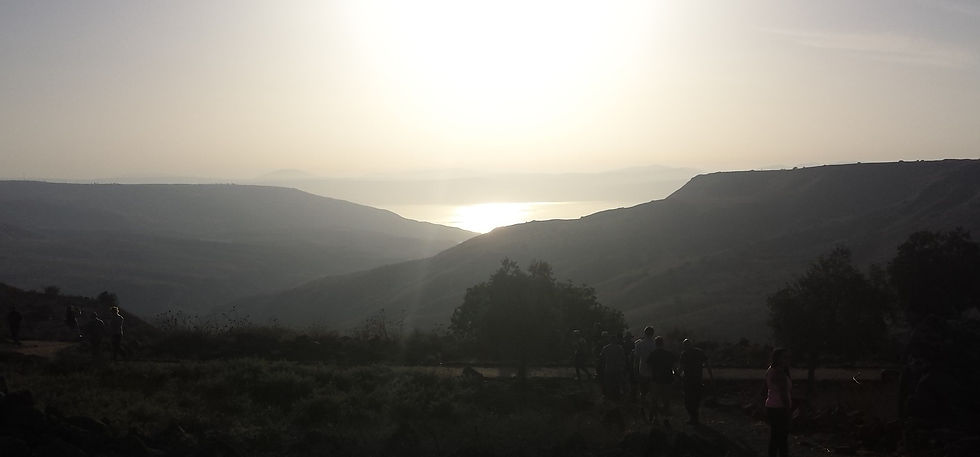
The Golan is often visited for its basalt landscapes, waterfalls, and views of Galilee. But beneath this image of a vast volcanic plateau lies another, older, and more subtle interpretation of the territory. In the Bible, in the narratives of the Second Temple period, and later in the remains of village synagogues, the Golan appears as a region of passage, refuge, border, and rural Jewish life.
For those seeking to understand the Jewish Golan, the stones speak almost as much as the texts. They tell the story of a world of small communities, basalt houses, wine presses, synagogue benches, and ancient inscriptions. Here are the essential landmarks to help you understand this territory before exploring it.
The Golan Heights in the Bible Begins as a City of Refuge
The name "Golan" appears in the Hebrew Bible as that of a city located in Bashan, a fertile region east of the Jordan River. The most frequently cited passage is found in Deuteronomy:
Then Moses separated three cities beyond the Jordan toward the sunrising; that the manslayer might flee thither, that slayeth his neighbour unawares, and hated him not in time past; and that fleeing unto one of these cities he might live: Bezer in the wilderness, in the table-land, for the Reubenites; and Ramoth in Gilead, for the Gadites; and Golan in Bashan, for the Manassites. (Deuteronomy 4:41-43)
The Bible recounts this decision of Moses in Joshua 20:8, where Golan is part of the network of cities of refuge that served a specific legal and social function. They offered protection to a person accused of manslaughter until their case was examined according to the law. The significance of this rule is often underestimated today. But let us consider that it was established in a Jewish law more than 3,300 years ago !
Joshua 21:27 adds another element: the Golan Heights are specifically assigned to one of the Levite families, the descendants of Gershom. This assignment was therefore established around 1250 BCE and is also mentioned in 1 Chronicles 6:56.
These references reveal three important points.
Golan was first and foremost a Jewish place name, more precisely a city of refuge.
This city was located in biblical Bashan, in a region attributed to Manasseh.
The name Golan was later used to designate a larger Jewish region, especially from the reign of King Herod and the subsequent Roman period.
The Bible does not provide the etymology of the word Golan. Therefore, one must remain cautious about its uncertain meaning. What can be said with certainty is that the biblical name "Golan" survived in the historical memory of the region. In sources from the Second Temple period and the Roman era, we find a similar Greek form, Gaulanitis, which designates the Golan district.
The modern plateau thus bears an ancient name, rooted in a biblical city whose exact location remains debated.

From Biblical Bashan to Ancient Gaulanitis
To understand the ancient Jewish sites of the Golan Heights, one must imagine a region less isolated than it appears today. The plateau connected several worlds: Galilee to the west, the Hauran to the southeast, Syria to the north, and the Jordan Valley below.
Its lands, though volcanic, were well-suited to agriculture. Villages thrived on grain, vineyards, olive groves, livestock, and local trade. Basalt, an abundant black stone, was used for all kinds of construction: houses, walls, lintels, wine presses, and... synagogues.
From the Second Temple period onward, under King Herod, several Jewish communities settled or flourished in the Golan Heights. After the destruction of the Temple in Jerusalem in 70 CE, Jewish life did not disappear from the region; on the contrary, it flourished, as Judea and Jerusalem became forbidden to Jews. But it changes form: synagogues become religious, social, and community centers. This is particularly evident in villages from the late Roman and Byzantine periods.
It is this continuity that makes the ancient synagogues of the Golan Heights so important for understanding ancient Jewish sites in the Golan. They are not merely monuments. They show how a rural Jewish population organized its daily life far from major urban centers.
Gamla reveals the Golan of the Second Temple period
Gamla is arguably the most spectacular site in the ancient Golan. The city sits on a steep ridge, surrounded by ravines. Its name likely derives from its shape, which resembles the back of a camel, gamal in Hebrew, as Josephus mentions in his book "The Jewish War":
The city was situated upon a rough ridge of a high mountain, [...] it is like a camel in figure, from whence it is so named, [...] On its acclivity, which is straight, houses are built, and those very thick and close to one another. The city also hangs so strangely, that it looks as if it would fall down upon itself, so sharp is it at the top. (Josephus, War of the Jews, IV, I, 1)

The site is known thanks to Josephus, a 1st-century Jewish historian, who recounts its fall to the Romans during the Great Jewish Revolt. Gamla fell in 67 CE, after a seven-month siege led by the troops of Vespasian, who had been sent by Nero to quell the revolt. Vespasian arrived with three legions: the V Macedonica, the X Fretensis (this legion, with a boar as its symbol, was subsequently stationed in Judea and Jerusalem for over 200 years), and the XV Apollinaris. Each Roman legion comprised 5,000 fighters. Therefore, the siege of Gamla was undertaken with 15,000 legionaries, and an equal number of auxiliaries, plus cavalry, totaling no fewer than 30,000 besiegers. The story is dramatic (see The Jewish War, Book IV, Chapter I, Section 4 and following), but the site itself helps us understand why the city withstood the attack so well. The terrain is a natural fortress.
Sights to see on site:
The remains of the city wall and the area where the Roman attackers breached it.
The remains of a 1st-century synagogue.
The ruins of dwellings clinging to the steep slope.
The traces of the Jewish city destroyed during the Roman assault.
The Gamla Synagogue is essential. A rare detail: it predates the destruction of the Second Temple in 70 CE, making it a rare witness to Jewish religious life at the time when the Temple in Jerusalem still stood. It serves as a reminder that synagogues were not simply substitutes for the Temple after 70 CE. They already played a role in study, assembly, and community life. The Gamla synagogue is one of only seven synagogues in Israel that predate the destruction of the Temple. And the world wants to believe that the Golan Heights have no Jewish roots and is boycotting the fine Gamla wine, produced locally, which honors this biblical name!

Visiting the ancient site of Gamla requires a bit of physical effort. Access is from the visitor center located on the plateau opposite, which is managed by the National Parks. The path descends and then ascends, following the route taken by Vespasian's legionaries. But the experience is powerful, as the unique topography, the ruins, and the historical account of Josephus resonate with one another.
Katzrin Shows Life in a Talmudic Jewish Village
Katzrin, in the heart of the Golan Heights, is one of the best places to understand daily life during the Talmudic period. The archaeological park presents the remains of a Jewish village from the first centuries CE, with its basalt houses, courtyards, domestic spaces, and ancient synagogue.

The site is not just an isolated ruin. It allows us to visualize an entire village. This is invaluable, as many travelers visit ancient synagogues without always seeing the surrounding (often rural) environment.
Things to see in Katzrin:
The basalt synagogue, with its columns and massive stones.
The reconstructed or partially restored houses.
The spaces related to agricultural and domestic work.
The thresholds, walls, and alleyways that give an idea of the village layout.
Katzrin helps us ask a simple question: who used these synagogues? Not just famous sages or pilgrims. Families, farmers, artisans, children. The synagogue was at the heart of a network of local relationships. People prayed there, read the Torah, and gathered there three times a week.
The visit becomes even clearer if it begins at the Golan Archaeological Museum, located in the modern town of Katzrin. There, you'll find artifacts, inscriptions, and explanations that provide context for the sites scattered across the plateau. The museum displays items on two different themes: the prehistoric archaeology of the Golan and the Roman siege of Gamla.
Umm el-Kanatir Impresses with its Synagogue
Umm el-Kanatir, called Ein Keshatot in Hebrew, is one of the most significant sites in the ancient Golan. The Arabic name means "mother of the arches," referring to the arches associated with the nearby spring. The modern Hebrew name, Ein Keshatot, means "spring of the arches." The name of the ancient village that housed this synagogue is unknown. However, the possibilities seem to be narrowed down to two hypotheses put forward by historians based on the Talmud.
The site is best known for its monumental synagogue, dating from the Byzantine period. It had collapsed, probably as a result of the earthquake of 749. Its recent restoration has replaced many of the original stones in their original positions, thanks to meticulous surveying and assembly.
The highlight of the visit is the hekhalite, the holy ark or monumental niche designed to house the Torah scrolls. This term refers to the word hekhal, which was the sanctuary inside the Temple in Jerusalem, destroyed by the Romans. The coined term hekhalite means something like "small sanctuary," which replaced the destroyed sanctuary.

Its presence is a reminder of the building's spiritual orientation and the central role of Torah reading in the community.
Not to be missed:
The synagogue's facade and interior.
The sculpted basalt stones.
The spring and its arches.
The contrast between the massive architecture and the open landscape of the southern Golan Heights.
Umm el-Kanatir also demonstrates the level of wealth enjoyed by some Jewish villages in the Golan Heights during the Byzantine era. Building such a synagogue required resources, skilled craftsmen, and a well-organized community.
Deir Aziz retains the charm of a more understated site
Deir Aziz is located near the Kanaf area in the southern Golan Heights. Its name is derived from the Talmud, which mentions the village of Azizo, and this name is confirmed by the archaeological discovery of a Greek inscription on one of the stones. It is believed that after the earthquake of 749, the site was transformed into a monastery or church following the Arab conquest, particularly due to its name, Deir Aziz (which literally means the monastery of Aziz in Arabic).
The site is less monumental than Umm el-Kanatir, but it offers a more tranquil experience. The remains of the synagogue blend into the landscape, along with a spring and traces of ancient occupation. As is often the case in the Golan Heights, basalt predominates. This stone lends the ruins a particular, almost austere, strength. The walls seem to rise from the ground.

What to look for:
The elements of the ancient synagogue.
The reused stones and architectural fragments.
The proximity of water, essential to village life.
The connection between housing, agriculture, and the place of prayer.
Deir Aziz reminds us that not all sites should be interpreted as major monuments. Some are valuable for their atmosphere and their ability to reveal the true scale of an ancient Jewish village.
Ein Nashut and Dabura complete the map of Jewish villages
Ein Nashut is another important site in the central Golan Heights. The remains of an ancient synagogue and a village have been identified there. Decorated elements, including Jewish motifs such as the menorah (the seven-branched candelabrum that was part of the Temple's furnishings), have helped to establish the Jewish character of the site.
The site generally requires more attention, as it is less developed than the major archaeological parks. But it also reveals how the villages formed a network. Each synagogue was not an isolated case; it belonged to a constellation of communities scattered across the plateau.
Dabura, also called Kfar Debora, near the Gilaboun Nature Reserve, is best known for its ruins and an inscription associated with rabbinic tradition. A basalt lintel bearing a legible Hebrew inscription was discovered there: This is the beit midrash (house of study) of Rabbi Eliezer Ha-Kappar. This find provided rare material evidence directly linking a prominent sage of the Mishnah (a 1st-century text, a precursor to the Talmud) to a rabbinical school on the Golan Heights. Other fragments related to the synagogue have been found in the area, some of which are preserved or displayed in museums. The site invites comparison with the archaeological objects seen at the Katzrin Museum.
These more modest sites offer an important lesson: the Jewish history of the Golan Heights is not confined to Gamla or two large, restored synagogues. It is revealed in a series of villages, inscriptions, lintels, wine presses, and roads. Golan archaeologist Professor Haim Ben David has identified some 45 ancient Jewish sites in the region, about 30 of which contain a synagogue.
What the Synagogues of the Golan Heights Teach Visitors
The ancient synagogues of the Golan Heights share several common features. Recognizing them enhances the visitor experience.
Basalt lends a local identity
Unlike the synagogues of Galilee, sometimes built with light-colored limestone, those of the Golan Heights largely utilize volcanic stone. It is heavy, dark, and difficult to work. The sculpted decorations appear with a very strong presence.
The synagogue is at the heart of the village
It cannot be understood in isolation. Around it, one must imagine houses, fields, herds, wine presses, paths, and families.
Jewish symbols are visible but sometimes understated
Menorahs, arch motifs, inscriptions, the building's orientation, and the interior layout all help to identify the religious function of the place.
The continuity is not linear, but it is real
Between the biblical Golan Heights, Gamla in the 1st century, and the Talmudic or Byzantine villages, the periods change. Populations, powers, and borders evolve. Yet, the name, the texts, and the ruins reveal an ancient, multifaceted, and enduring Jewish presence.
How to plan a worthwhile visit
For a first visit, a simple itinerary can follow three stages.
Begin with Gamla to experience the historical upheaval of the 1st century and its connection to the revolt against Rome. The topography there makes history very tangible.
Continue with Katzrin, home to the archaeological museum and the Talmudic village. This is the best place to understand the artifacts, inscriptions, and daily life of the ancient Jewish villages of the Golan.
Finish with Umm el-Kanatir, which showcases the architectural power of a rural synagogue from the Byzantine era.
With more time, adding Deir Aziz, Ein Nashut, or Dabura allows you to venture beyond the most well-known sites and better grasp the density of the ancient Jewish presence.
A few practical tips are still useful. The Golan Heights is a border region, with natural, military, and protected areas. It's essential to stay on authorized roads and trails, check access conditions before setting out, bring water, and wear good hiking shoes. In summer, the heat can make hiking more challenging. In winter, the wind and mud quickly alter the experience.
The biblical Golan Heights is more than just an ancient name on a map. It unfolds in layers: a city of refuge in the Bible, a district known to ancient authors, a rebellious city in Gamla, and then Jewish villages whose basalt synagogues still bear witness to their past. Visiting these sites means learning to read a territory where history isn't confined to a museum. It still surfaces in the black stone, the springs, and the ruins open to the sky.
The Golan Heights is a region rich in sites to visit. Besides the ancient Jewish villages and their synagogues, other themes may interest visitors: volcanology, Israeli wars (including the Six-Day War and the Yom Kippur War), Druze villages, a tour related to the spy Eli Cohen, nature, agriculture, wine tasting tours, and much more.
To visit the Golan Heights, the best option is to contact an official guide with an all-terrain vehicle and discuss a specific area or theme you wish to explore. Feel free to contact me or one of my colleagues to arrange a tour.
Albert Benhamou
Private licensed tour guide in Israel
Heshvan 5787 - October 2026


Comments