


Celebrating Tu Bi-Shevat: A Journey Through Nature and Tradition
Updated: May 6
Understanding the Significance of Shevat
In the months of January and February, we find ourselves in the Hebrew month of Shevat, the eleventh month of the Jewish calendar. As I have explained in another article (to read it, click here), the Jewish calendar is lunisolar. This means it is solar for years and seasons, while lunar for months. Therefore, the first day of a Hebrew month always falls on the New Moon (the dark night), and the 15th of the lunar month aligns with the Full Moon. The term Tu Bi-Shevat (ט"ו בשבט) translates to the 15th day of the month of Shevat, marking a Full Moon night.
Interestingly, the number 15 is not represented by the numbers 10 (the letter yod) and 5 (the letter héh), as one might logically expect. Instead, it is represented by the numbers 9 (the letter tèt) and 6 (the letter vav). This is done to avoid using the letters yod and héh, which are reserved for the divine name. Thus, the 15th of the month is referred to as "Tu" (ט"ו), a contraction of the letters tèt and vav in Hebrew. For more information on the Jewish symbolism of numbers, click here.
The Unique New Year of Tu Bi-Shevat
The 15th of Shevat is unique as it counts as one of the four New Years in the Jewish calendar. This may seem strange to those who are accustomed to only knowing January 1st as New Year's Day. However, the Jewish calendar operates differently. There is, of course, a New Year for "years", known as Rosh Hashanah, which falls on the 1st of the month of Tishrei. Additionally, there is a New Year for religious festivals, which is on the 1st of the month of Nisan. Biblical kings of Judea traditionally counted their reigns from this date.
Moreover, the 1st of Elul serves as a New Year for animal tithes, as it is a month of repentance and expiatory sacrifices leading up to the divine judgment month of Tishrei, which includes Rosh Hashanah and Yom Kippur. Finally, the 15th of Shevat marks the New Year for the blossoming of trees, heralding the return of spring and life on Earth. From this date, the soil of the Land of Israel regains its strength after the rainy season, allowing it to fulfill the divine command of creation to bring forth plants (Genesis 1:11-12).
The Celebration of Nature and Renewal
Unlike other holidays, the day of Tu Bi-Shevat is not celebrated as a solemn festival and is not a day of rest. This is because, unlike other holidays instituted by divine order, this New Year was established by religious authorities. Its date was set on the 15th of Shevat over 2000 years ago by Hillel, a rabbi from the first century BCE. Hillel expressed what was later reiterated in the Talmud: it is the time from which the majority of the annual rains have already fallen (Rosh Hashanah 14a).
In the cycle of nature, the first tree to bloom in Israel is the almond tree. Its flowering signifies the onset of spring. Surprisingly, the almond tree is also the last to bear fruit (the almonds) in the autumn. Thus, the almond tree witnesses the entire annual cycle of nature: from the blooming of trees to the production of their fruits, marking the journey from early spring to late autumn. Following this, winter arrives, during which nature lies dormant until the following spring.

As we can see, Tu Bi-Shevat is the celebration of the earth's renewal. For this reason, the date of the 15th of Shevat was also chosen, not by chance, as the date for the establishment of institutions in Israel. For example, the laying of the first stone of the Hebrew University of Jerusalem took place on Tu Bi-Shevat in 1918, the Technion in Haifa on Tu Bi-Shevat in 1925, and the Knesset on Tu Bi-Shevat in 1949.
Traditions and Customs of Tu Bi-Shevat
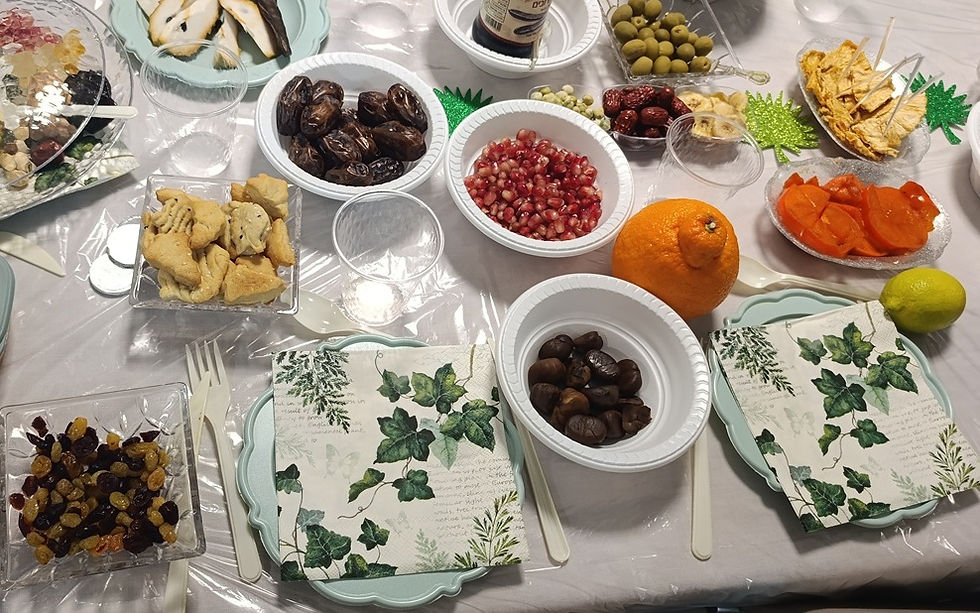
To celebrate Tu Bi-Shevat, it is customary to consume new fruits. This allows us to recite the blessing Shéhé-chéyanu to thank the Creator of the World for allowing us to live until this moment, supporting us to reach this day. In particular, the seven species mentioned in the Bible (Deuteronomy 8:8) are highlighted as representative of the produce of the Promised Land. These seven species (שבעת המינים) are wheat (חיטה), barley (שעורה), the vine (גפן), fig (תאנה), pomegranate (רימון), olive (זית), and honey (דבש) derived from dates (תמר).

In the 16th century, in Safed in Galilee, Isaac Luria (known as the 'Ari), who taught Kabbalah, gave this holiday a spiritual dimension for the renewal of the Land of Israel. Thus, Tu Bi-Shevat symbolizes the annual divine judgment of His creation, particularly concerning trees. Why must trees be judged? Because, like humans, trees also sinned during creation: God commanded one thing (Genesis 1:11), and the trees executed the order incompletely (Genesis 1:12). Therefore, there must be a rectification (tikun in Hebrew) just as there is for human transgressions. In this sense, Tu Bi-Shevat takes on the value of a Rosh Hashanah (a New Year) of atonement and forgiveness, but specifically for trees. Who acts as the "advocate" for the trees before the divine? Humans, through the celebration of Tu Bi-Shevat, the day of judgment for trees.
Trees also symbolize growth, roots, and resilience. This is why humans, rooted in their sources and traditions, are compared to the tree of the field in a biblical metaphor (כִּי הָאָדָם עֵץ הַשָּׂדֶה: Deut. 20:19), emphasizing their connection to nature. Humans are seen as a bridge between earth and heaven, requiring earthly and material roots (representing tradition and thus the Torah) to reach toward the heavens (representing spirituality). This is why Kabbalah also represents the spiritual levels of humans, from the material to the divine, through the Tree of Life.

Thus, Luria and his disciples, most of whom were of Sephardic origin, instituted what is now referred to as the "Seder" of Tu Bi-Shevat. This involves a specific order of the products of the earth to consume and blessings to recite regarding them. Today, in Israel, the tables for the Tu Bi-Shevat meal are adorned with platters of fruits, pastries, and wine, for which it is customary to recite specific blessings. According to traditions, the 15 Psalms from 120 to 134 are read. Why these 15 Psalms? Of course, there is the fact that the holiday falls on the 15th of Shevat. But there is more. Jewish sources describe 15 steps that the Levites had to ascend to reach the Temple gate while singing these 15 Psalms, known as the "Songs of Ascents" (Shir Hama'alot in Hebrew). These 15 steps are symbolically linked to these 15 songs and represent an ascent from a lower level to a higher level of holiness, echoing the 15 Psalms.
One can also note that to reach the date of the 15th of Shevat, we begin the month of Shevat on the 1st, which is the dark night, and we reach the 15th of the month, with the Full Moon, representing the brightest night light. Here again, this transition from the deep darkness of night to its highest illumination corresponds to the progression from the material to the spiritual.

The Symbolism of Trees in Scripture
Trees hold a very special place in human scripture. In the Garden of Eden, two special trees are mentioned in Genesis: the Tree of Life and the Tree of Knowledge of Good and Evil. Therefore, for this holiday celebrating nature and trees, you can read my article on the emblematic trees of Israel by clicking here use Gogle Translate as it is in French).
Albert Benhamou
Private tour guide in Israel
February 1, 2026, 15 Shevat 5786

Comments