


From Megiddo to Armageddon
One of the most visited archaeological sites in Israel is Megiddo, located on the eastern slope of Mount Carmel, overlooking the vast Valley of Jezreel, the site of the messianic battle of Armageddon according to the Book of Revelation. Needless to say, many Christian visitors come to this site. Messianic times are a hot topic right now, both among Jews and Christians, and it is therefore important to raise awareness of this place toward which so many eyes are turned.
This article aims to answer these questions: What is the history of Megiddo? What can be seen there? Why does the Book of Revelation declare that the final battle of the end times will take place there?
History of Megiddo
First, it's important to note that the site has been recognized as a UNESCO World Heritage Site since 2005. To learn more about these special sites in Israel, click here. Megiddo is a "Tel" (or Tell), meaning a hill upon which several generations of human settlements have succeeded one another through successive destructions and reconstructions. There have been more than twenty such successions in Megiddo.
The history of Megiddo began in the Early Bronze Age, approximately 4,500 years ago, when humanity began building "cities" in Mesopotamia and also in the land of Israel. Religious practice was beginning to gain importance, and these early inhabitants built a sacrificial altar in Megiddo, circular in shape with a few steps leading up to it. For where there is worship, there is elevation: sacrifices had to be performed on a platform called a bama in Hebrew.

But a little over 4,000 years ago, the Early Bronze Age came to an abrupt end, and the cities were suddenly abandoned for a relatively short period of 100-200 years. History has yet to definitively explain the reason for this abandonment, which wasn't linked to a particular site but was widespread throughout the Fertile Crescent, from Mesopotamia to Egypt. For believers in the Bible, the explanation is simple: the Flood was the cause, so it wasn't sudden abandonment but sudden divine punishment that wiped out humanity in one go. This cataclysm has been echoed in ancient accounts uncovered by archaeology (to learn more, click here).
Then life resumed. People settled again in Megiddo. But with the manufacture of bronze tools and weapons, and the wars they caused, the type of urbanization changed: this was the Middle Bronze Age and the emergence of fortified city-states. The region became known as Canaan. Megiddo saw the construction of its first defensive wall and its first city gate.

These Canaanite cities were often in conflict with one another until a powerful invader (the Hittite Empire) came to subjugate them and establish order. This marks the beginning of the biblical period of the Patriarchs (for example, to follow the patriarch Abraham in Canaan, click here). Throughout the rest of the Fertile Crescent, similar upheavals were caused by the rise of empires: Hammurabi (the biblical Nimrod) built an empire in Mesopotamia (click here to learn more), while invaders from Asia, the Hyksos, conquered Lower Egypt and settled there permanently (click here to learn more) until Ahmose I, the founder of the 18th Dynasty, succeeded in expelling them. It was under this pharaoh that the period of Hebrew presence in Egypt began and lasted until the end of the 18th Dynasty, one of the most prosperous dynasty in Egyptian history. And it was under this dynasty that Pharaoh Thutmose III conquered Canaan and its city-states, including Megiddo, a conquest that nevertheless cost him a long seven-month siege. Canaan then fell under Egyptian rule until the arrival of the Hebrews, who became the Israelite people after their Exodus from Egypt (for the exact date, which is still debated, click here), around 1250 BCE.
Despite the Israelite conquest of Canaan, Megiddo retained its independence until King Solomon made it one of the three administrative and military capitals for the central district of his kingdom. The Israelite gate of the city, distinct from the Canaanite gate, was built according to the same plan for these three important cities (to learn more, click here). After his death around 928 BCE, Megiddo came under the control of the northern Israelite kingdom, an impious kingdom in conflict with the Kingdom of Judah, where the legitimate dynasty descending from David and Solomon reigned.
Taking advantage of this fratricidal conflict between the two Israelite kingdoms, Pharaoh Shoshenq (the biblical Shishak) of the 22nd Dynasty campaigned against the Israelite cities around 925 BCE and inscribed Megiddo on a wall of the Karnak temple as one of his victories (to see this inscription and learn more, click here). Furthermore, it was at Megiddo that a fragment of a victory stele mentioning Shishak was found in 1925 excavations.

Megiddo reached its zenith under the reign of Omri, King of Israel, in the 8th century BCE: additional fortifications were erected, the city's water supply system was improved, and so on.
But this was also the era of the rise of another northern empire: Assyria. Tiglath-Pileser III conquered Megiddo in 733 BCE. The Kingdom of Israel finally fell in 722 BCE after successive Assyrian campaigns. Many Israelites fled the war from the north and sought refuge in the neighboring Kingdom of Judah in the south, centered around its capital, Jerusalem. Others were deported to the borders of the Assyrian Empire and became what are commonly referred to as the Ten Lost Tribes of Israel.
The Assyrian Empire, in turn, fell to a Babylonian general: Nebuchadnezzar. A large coalition attempted to defeat him at the Battle of Karkar in 609 BCE, but without success. However, the passage of Pharaoh Necho's Egyptian army through the Kingdom of Judah caused friction with the pious King Josiah, who was executed near Megiddo. The Kingdom of Judah, and the rest of the Levant, was finally conquered by Nebuchadnezzar in 604 BCE. It was during this campaign that the city of Lachish, the most important in Judah after Jerusalem, fell a second time, as evidenced by inscriptions discovered during its archaeological excavations in the 1930s (to learn more, click here). Jerusalem finally fell, with its Temple of Solomon destroyed, in 586 BCE. Judah was emptied, and Megiddo was abandoned. Abandoned forever in fact but, yet, it still speaks of itself...
From the Hellenistic era onward, the ancient cities built atop hills (the famous "Tels") were abandoned in favor of new cities at the foot of these hills: this was the case with Megiddo and many others. Why? Because, for the first time in history, very large empires took possession of vast territories, and thus peace reigned throughout their entirety. What were these empires? Successively the Babylonian Empire, then the Persian Empire, then the Hellenistic Empire, then the Roman Empire, and so on.
It was during the Roman Empire that the Sixth Legion established itself near Megiddo. This site was called Legio by the Romans and then el-Leijun by the Arabs: it's the same word.
The land of Israel then lay dormant for some 1300 years under Muslim rule, until 1918. Just before the end of World War I, the British, under the command of General Allenby, completed the conquest of the land of Israel and expelled the Ottomans (who had become Turks) who had ruled the region for 400 years. How was Megiddo taken in 1918? Allenby, who knew the Bible and history, had read that Pharaoh Thutmose III had conquered this ancient city by surprise after crossing the Aruna Pass through Mount Carmel. Some 3400 years separate the two conquests, both using the same tactic! The future belongs to those who know history! Fortunately, today, we can simply drive through this pass. But as you drive, look to your right to identify the riverbed of the small stream that the two conquerors followed to stumble upon Megiddo.
Allenby, a devout believer, was granted a peerage for the conquest of the Holy Land. Before entering the House of Lords in London, he had to choose a title: he chose the title of "Lord of Armageddon". The name Armageddon is actually the Greek (Ἁρμαγεδών) transliteration of the Hebrew name Har Megiddo, which means the mountain of Megiddo. For some, his lightning campaign fulfilled a biblical prophecy. And it is there, according to the Book of Revelation, that the final battle of the end times will take place between the forces of Evil and the forces of Good:
And they gathered together at a place which the Hebrews call Armageddon. (Revelation 16:16)
Moreover, the name Allenby is written in Hebrew as אלנבי. If we transpose the two syllables אל נבי, writing them נבי אל, it means Prophet of God!
History of Archaeological Excavations at Megiddo
The first to have an intuition about the biblical site was Robinson (the one who gave his name to Robinson's Arch in the remains of the Second Temple) around the mid-19th century. The site was called Tell el-Mutsellim in Arabic.

At the beginning of the 20th century, the Turks planned to build a railway line for the Hejaz to connect Haifa to Damascus. A certain Gottlieb Schumacher, a member of the Templars in Palestine (to learn more, click here), was employed to survey the land along the proposed route and, in doing so, explored several sites, including Megiddo. However, archaeological excavations took place during the British Mandate, between 1925 and 1939, by a team from the University of Chicago. They were the ones who uncovered the cult site and dug a huge trench through the hill to access it. This trench is still visible today and marks the site.

Fun fact: The date palms found at the Megiddo site (as in the photo above) are not ancient. They are palms that grew from date pits that Arab workers in the early 20th century ate during the archaeological excavations and then discarded on site!
Then, after the establishment of the State of Israel, excavations were continued by Yigal Yadin (who conducted the first excavations at Masada) in the 1960s. In the 1990s, it was Israel Finkelstein's turn, followed by David Ussishkin. This means that the Megiddo site has been excavated for a good hundred years!
What to see in Megiddo?
The site is managed by the National Parks Authority, so there is a small entrance fee. In the visitor center, don't miss the exhibition, the model, the history of the excavations, the ten-minute film, and even the photos of Pope Paul VI's historic visit to Israel in 1964: Armageddon was immediately added to the map of Christian pilgrimages.

Here are the main places to see:
Canaanite Gate: with two guard cells on each side, facing north; made of limestone and basalt (dark in color). Gates with two sets of two cells are typical of Canaanite cities. The Megiddo gate was later incorporated into the gate system during the Israelite period with the addition of a 3x2 gate, typical of the time of Solomon and the Judean kings who succeeded him. Between the Canaanite gate and the added Israelite gate, there was a space that served as an agora in Greek cities, namely a public meeting place for the city's merchants and suppliers arriving from elsewhere. This layout can be found in many Canaanite cities restored later during the Israelite period.
North Palace: in ruins, probably dating from the time of Solomon or Ahab; from here, one can admire the panorama of the Jezreel Valley, which can be seen as far as Mount Tabor and Gilboa: this is the valley of Armageddon!
Cultic area: several temples had been built here, one on top of the other. The circular altar from the Early Bronze Age, with its staircase leading up to the bama, predates the Canaanite temples built later. Its round shape symbolizes the full moon. This pagan cultic area was used continuously until the Israelite monarchy established over the region.
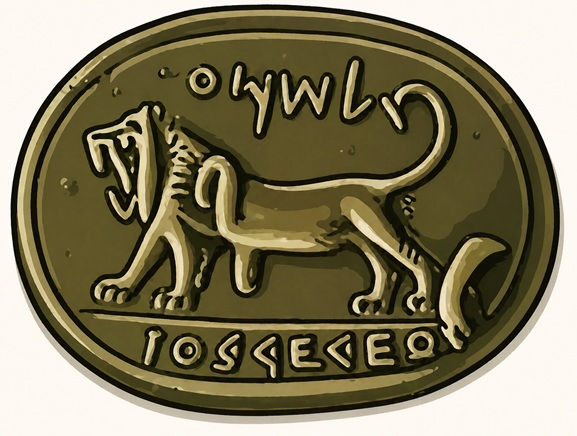
South Palace: Nothing remains of this site except for the discovery of the "Lion of Megiddo" there in 1904 by Schumacher. This roaring lion is a jasper seal bearing the inscription in Proto-Hebrew: "Shem'a, servant of Jeroboam." At the time of its discovery, this seal was the oldest known to bear the name of a king of Israel, Jeroboam II. Unfortunately, the seal was lost after being sent to Istanbul. However, a bronze impression had been made before its shipment. It is worth noting that this seal belonged to an official of the king of Israel, while the lion is a symbol of Judah. But Jeroboam II, despite being an impious king like all the kings of Israel, had a restrained policy toward the kingdom of Judah. As a result, he enjoyed a long reign of 41 years. It seems that he too used the lion as a symbol, not to claim the throne of Judah, but as a symbol of power. Indeed, did not the prophet Amos, a contemporary of Jeroboam II, declare against him, The lion has roared; who will not be afraid? (Amos 3:8)
Grain silo, dating from the reign of King Jeroboam II of Israel (8th century BCE), circular in shape with a stone staircase leading down to it; it has a capacity of 450 m³.

Stables: As explained here, Megiddo became an administrative and military capital as early as the reign of Solomon. Chariots and horses were a major military asset at that time, and the Hyksos had even used them in their conquest of Egypt when their enemy had not yet acquired this technology. Later, during the Canaanite period, the capture of the Canaanite chariots of Megiddo was noted during the campaign of Thutmose III. In the Bible as well, the power of an army was measured by its number of soldiers and chariots (and not by the number of cavalry). It seems that the number of chariots and horses was highest during the reign of King Ahab of Israel, who, according to the Bible, sent 2,000 chariots to fight against the Assyrians.
The water system: the water supply of an ancient city was one of the three fundamental criteria for its existence. In the case of Megiddo, a natural spring existed, but it was located at the foot of the hill, as was the case with the Gihon Spring in the City of David in Jerusalem. How could this spring, located outside the city, be accessed in the event of a siege? The Canaanites had built a hidden passage on the hillside, which remained in use until the reign of Solomon. Later, a more elaborate system was constructed and is still visible today: a shaft was dug within the city to a depth of 36 meters; then a nearly horizontal tunnel, 70 meters long, was excavated, passing under the city walls to reach the water source. This system, carved directly into the hillside, was thus hidden from the eyes of attackers. On the other side, at the spring, its existence also had to be concealed: a massive stone wall had been built to block access to the spring from the outside. Caution: before entering the water system, be aware that there are 183 steps to descend and then 80 steps to ascend; and, ultimately, you will inevitably end up outside the ancient city and must return to the visitor center via the approximately 600-meter path that circles the hill. Those who suffer from claustrophobia should refrain from attempting this underground circuit.

Armageddon
Having explained the history of the site and what there is to see, we must now answer the question: why does the Book of Revelation declare that the final battle of the end times will take place here? The text of Revelation actually echoes several biblical prophecies of Israel. One prophecy in particular speaks of the final battle between the forces of Good and Evil, a battle that God will win after heavy losses for the people of Israel:
"On that day I will destroy all the nations that have come against Jerusalem. (...) On that day there will be great mourning in Jerusalem, as there was mourning for Hadad-Rimon in the Valley of Megiddon." (Zechariah 12:9-11)
Zechariah was one of the last prophets of Israel. His entire book is prophetic. What mourning in Jerusalem was he referring to as having occurred in the Valley of Megiddo? The mourning for the death of good pious King Josiah, executed before Megiddo by Pharaoh Necho. The king's body was then taken to Jerusalem for burial. (2 Kings 23:29) Therefore, according to Zechariah, the people of Jerusalem, besieged by all nations at the end of days, will mourn their dead as they had mourned the death of Josiah.
The Jewish and Christian scriptures thus indeed speak of the valley opposite Megiddo as the site of the final battle at the end of days.

The archaeological site of Megiddo is accessible by car on Route 66, near the access point to Route 6. Wait... 66 and 6 make 666: doesn't that remind you of something? It makes you wonder if the officials who decided on the road names were giving us a wink!

Albert Benhamou
Private tour guide in Israel
Kislev 5786 - December 2025


Comments