


History and architecture of Tel Aviv
Tel Aviv sometimes gives the impression of being a recent, sun-drenched city, turned towards the sea and the night. Yet, beneath its cafes, shaded boulevards, and white buildings, the city tells the story of more than a century of urban planning, immigration, political dreams, and architectural experiments.
Understanding Tel Aviv is not simply about visiting a pleasant Mediterranean metropolis. It is about reading a city layer by layer, from port city Jaffa to contemporary towers, from the first houses built on the sand to the Bauhaus facades listed as UNESCO World Heritage sites.

A City Born on the Sands North of Jaffa
Tel Aviv's history truly begins in the early 20th century, but its setting is much older. Jaffa, now part of Tel Aviv-Yafo, was for centuries a major port on the eastern Mediterranean. Pilgrims, merchants, travelers, and migrants arrived by boat before continuing on to Jerusalem or the interior of the country.
In the early 1900s, Jaffa was densely populated, sometimes unsanitary, and lacking in space. A few Jewish neighborhoods, such as Neve Tzedek, had been established outside the city walls, but their inhabitants remained dependent on Jaffa, a predominantly Arab city.
A group of about sixty Jewish families then decided to launch a different project: to create a modern city outside the walls of Jaffa and no longer dependent on it. This city would be more spacious, therefore healthier, better organized, with wide streets and houses surrounded by gardens. After raising funds from patrons, with the aim of creating the first Jewish city in the Land of Israel in 2,000 years, they acquired a plot of land on the dunes north of Jaffa and launched the project in 1909. This association of future residents was called Ahuzat Bayit, which could be translated as "house partitioning."
The most well-known founding scene has almost the simplicity of an urban legend. The plots were supposedly allocated by lottery, with seashells bearing the names of the families and the plot numbers. The gesture was modest, but the ambition was immense. These houses, set upon the sand, became the nucleus of a new city.

The name Tel Aviv was adopted a few months later. It echoes the Hebrew title given to the translation of Theodor Herzl's utopian novel, Altneuland. The name combines the idea of an ancient mountain, Tel, with that of renewal, Aviv. From its very beginning, the city has thus borne a fruitful link between past and future.
Throughout Tel Aviv's history, three landmarks frequently recur: Ahuzat Bayit, Bauhaus, and Meir Dizengoff. The first refers to the city's founding, the second to its most celebrated architectural identity, and the third to one of its great political builders: Meir Dizengoff. As Tel Aviv's first mayor, he oversaw the city's rapid growth and remains associated with its image as a modern, dynamic, and secular metropolis.
Iconic Places That Tell the Story of Tel Aviv's Urban Evolution
Tel Aviv is best explored on foot if you're willing to connect neighborhoods by period rather than simply by proximity. Each area reveals a different stage in its development.
The starting point is undoubtedly at the foot of the artistic fountain created by Nahum Gutman (1898-1980), at the beginning of Rothschild Boulevard. Composed like a mosaic of colored glass, it depicts several scenes from the city's history, from Jaffa to Israel's declaration of independence in 1948. Other starting points, such as Jaffa and Neve Tzedek, are not directly related to Tel Aviv and would lengthen the visit. Separate tours should be arranged for these locations.

Dreyfus, Herzl, and the Gymnasia
You can begin your visit by taking a look at the statue of Captain Dreyfus, located behind the French Institute. It links the famous Dreyfus Affair to the founding of Tel Aviv, a connection reminiscent of Theodor Herzl's work. To understand this link, click here.
If you have time, and avoiding Shabbat hours, take a trip inside the Shalom Meir Tower. On the ground floor, there's a small museum open to the public with artwork depicting the founding of Tel Aviv, models of what Ahuzat Bayit was like, and numerous historical photographs of the city's development. On the first floor, accessible by escalator, don't miss the large model of Tel Aviv as the "White City," a nickname that reflects its Bauhaus character.

All around this model, you can see photographs of Bauhaus buildings throughout history, showcasing the city's landmarks. In an adjacent room, photographs of Tel Aviv's first school, the Herzliya Hebrew Gymnasium, are on display. This school was the first in the world to teach Hebrew. Founded in 1905, it was the first secondary school in the world to offer this type of instruction. The historic building was located at the top of Herzl Street, near the intersection with Rothschild Boulevard. Designed by Joseph Barsky, it evoked the Temple of Solomon as a new temple dedicated to education.

It was a major landmark of the city until its demolition in 1962 to make way for the Shalom Meir Tower. Its destruction sparked widespread public outrage and directly led to the creation of a council for the preservation of heritage sites and monuments in Israel (whose logo is inspired by the silhouette of the historic building).

Rothschild Boulevard tells the story of Tel Aviv's civic birth
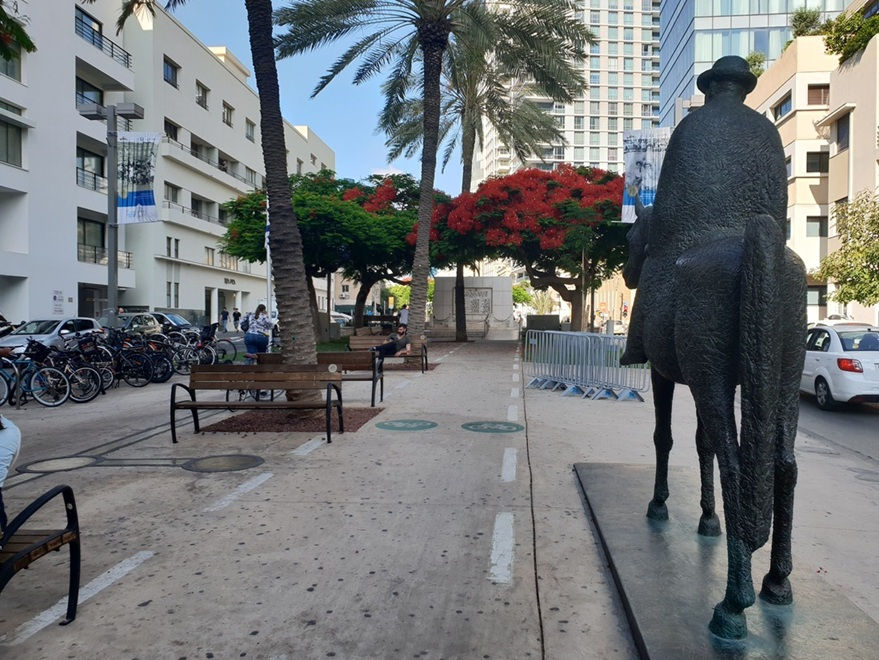
Rothschild Boulevard is one of the most important thoroughfares for understanding Tel Aviv. It follows part of the original city's layout and preserves several historic houses. You'll also see eclectic-style buildings, modernist Bauhaus and Le Corbusier-style structures, cafes, bike paths, and modern towers in the background. It's easy to walk along the central, shaded lane, reserved for pedestrians and cyclists. However, be sure to stay on the correct path. The starting point is likely the modern kiosk that marks the site of the historic kiosk with its electric lamppost (the original is in the museum on the ground floor of the Shalom Meir Tower).
Then, a short walk from the bandstand, is Independence Hall, housed in Meir Dizengoff's former home, which became an art museum after his death in 1936. On May 14, 1948, David Ben-Gurion proclaimed the creation of the State of Israel here. The building (currently undergoing renovation) lends a national dimension to a space already central to the city's history. Opposite the entrance, you'll see a bronze statue of Meir Dizengoff on horseback (this was how he used to get around town).
Continuing along the boulevard, you pass a wall inscribed with the names of the 66 families who participated in the Ahuzat Bayit project and were, in effect, the founders of Tel Aviv by building their homes on the initial plot. Behind the wall, which also features the city's first logo and a bronze artwork commemorating the city's history, you'll see a fountain: this is where the water tower that supplied the houses with running water once stood (remember, this was from 1909 onwards). Near this fountain was also Tel Aviv's first "city hall," which received "city" status in 1920 due to its growing population.

The second location for Tel Aviv City Hall is on Bialik Square (worth another detour if you have time). This square is so called because there is the house of the Israeli poet Haïm Nahman Bialik. The town hall building still exists and is now a cultural center.
Soon you arrive at the corner of Allenby Street. On your right is the building designed by Yehuda Magidovich, Tel Aviv's preeminent architect, who served as Tel Aviv's chief engineer between 1920 and 1923. He left his mark on the city with several public and private buildings, as well as the synagogue building located a few steps away on Allenby Street. Each of the buildings has a story that a guide can tell you.

A stroll along Rothschild Avenue offers a glimpse into what Tel Aviv has always aspired to be: a city of streets, promenades, social interaction, and projects. The colorful facades of its buildings, their decorative details, and their varied volumes provide a good introduction to the eclectic style of the 1920s. Before the triumph of the clean, white lines of the Bauhaus style in the 1930s, Tel Aviv favored ostentatious ornamentation, arches, elaborate balconies, and a multitude of references.
Ahuzat Bayit, Eclecticism, and Bauhaus: Transformations of the 1910s-1930s
The city began with a simple architectural style, that of Ahuzat Bayit, as early as 1909. These were small, single-story brick houses (a second story was often added later), like the historic home of Akiva Aryeh Weiss, one of Tel Aviv's principal founders.
Then, from 1920 onward, the style shifted to eclecticism. Architects blended European influences, oriental motifs, biblical references, and local solutions. The houses sought to create a new identity, but they still reflected the historicist taste of their time. Why at this precise moment? Because it was the end of the war and the beginning of the British Mandate, and therefore the hope of seeing the Balfour Declaration of 1917 implemented, which promised support for the establishment of a Jewish national home. At the time, people were buying old houses from the 1910s style and replacing them with so-called eclectic buildings. In the 1920s, a technological revolution also made it possible to build taller structures: the use of metal beams and frames to support the construction.
In the 1930s, the change accelerated. Architects trained in Europe arrived in Mandatory Palestine, some fleeing the rise of Nazism. They brought with them the principles of the Modern Movement and the International Style. Forms became simpler. Facades were smoothed. Volumes were composed of horizontal lines, rounded balconies, ribbon windows, pilotis, and vertical stairwells.

The word Bauhaus is often used in Tel Aviv as shorthand. While not all the buildings in what was then called the White City originated directly from the Bauhaus school, the modernist influence is undeniable. The city adapted these ideas to the Mediterranean climate.
Architects had to address very specific needs:
creating shade through balconies and setbacks,
promoting natural ventilation,
limiting the heat effect on facades,
building quickly to house a rapidly growing population,
giving a modern image to a young city.
The White City, a UNESCO World Heritage Site, refers to this exceptional collection of modernist buildings. Many can be seen around Rothschild Boulevard, Dizengoff Street, Bialik Street, and the Dizengoff Square area. If you are interested in UNESCO World Heritage sites, click here.

The route along Rothschild Boulevard ends at HaBima Square. While the beginning of the boulevard was marked by a temple of education (the Gymnasia High School), it ends with a temple of culture, as HaBima encompasses the HaBima National Theatre, the Bronstein Concert Hall, and the Ofer Pavilion of Contemporary Art. The entrance to the square is marked by the sculpture "Uprise" by Israeli artist Menashe Kadishman (1932-2015), composed of three massive steel discs balanced at a sharp angle. It creates a visual paradox because, depending on the viewing angle, it evokes either a powerful force rising toward the sky or an unstable pillar on the verge of collapse.

After 1948, a rapidly growing city
The creation of the State of Israel transformed Tel Aviv. The city played a central role in the country's early years, even though Jerusalem became the political and religious heart. Tel Aviv remained the economic, cultural, and media center.
In 1950, Tel Aviv and Jaffa were administratively united under the name Tel Aviv-Yafo. This merger did not erase the differences between the two areas. Rather, it created a city with a dual history: an ancient port and a modern city, Ottoman stone and white concrete, narrow alleyways and wide avenues.
After 1948, the architecture changed. The needs were immense. Housing, schools, public facilities, and administrative buildings were required. The 1950s to 1970s saw the emergence of many more understated buildings, sometimes constructed of exposed concrete. Some buildings reflect Brutalism, with their massive, functional, and often sparsely decorated forms.
This period is less photographed than the White City, but it is crucial for understanding Tel Aviv. It tells the story of a city absorbing rapid growth and seeking practical solutions. Public buildings, residential neighborhoods, and certain infrastructure reflect the urgency of construction.
The waterfront also evolved. The beach became a central space in urban life. Hotels, promenades, and coastal amenities shaped a more touristic, but also more local, image. In Tel Aviv, the sea is not just a backdrop; it serves as a daily landmark.
From the end of the 20th century onward, Tel Aviv entered a new phase. Skyscrapers became more numerous. Business districts developed. Avenues like Begin Road and the area around HaShalom Station changed in scale. The Azrieli Towers, with their geometric forms visible from afar, mark this new verticality.
The contemporary city is based on a stark contrast. On the one hand, Tel Aviv protects and restores historic buildings, especially those in the White City and its early neighborhoods. On the other hand, it builds upwards to meet real estate pressure and fulfill its economic role. The Sarona district provides a striking example of heritage reuse. A former German Templar settlement, the site has been restored and integrated into a very modern area (click here to learn more). The small houses with tiled roofs contrast with the nearby towers. The result may seem highly staged, but it demonstrates how Tel Aviv is transforming its heritage into places for walking, shopping, and leisure.

This article presents one example of a possible tour of historic and architectural Tel Aviv. Many other tours exist, all very interesting and picturesque. If you would like to arrange a tour of this city of contrasts, rich in history, architecture, anecdotes, and stories, please feel free to contact me or one of my fellow tour guides in Israel.
Albert Benhamou
Private licensed tour guide in Israel
Heshvan 5787 - October 2026


Comments