


Auschwitz timeline: 1940-1941
On the occasion of the 2026 Yom HaShoah commemoration in Israel, I felt it important to create a timeline of the history of the Auschwitz camp and its death camp, Birkenau. At a time when Holocaust education is being challenged, even eliminated in some countries, and when the Holocaust is being reduced to a mere genocide, however horrific and unacceptable any genocide is, I believe that reading this timeline will help those who wish to better understand what the Holocaust was and why it was unique in the long list of massacres and genocides that the world has known and continues to know.
This timeline contains period photographs, illustrations, numerous testimonies, and historical sources.
Warning: some testimonies and illustrations may be disturbing. How could they be otherwise? Therefore, each reader should exercise their own judgment.
As this timeline is a bit long as it aims to be as complete as possible, I have divided it into periods. Here, to begin, is the first period, covering 1940-1941. The other periods follow in sequence.

April 27, 1940: SS officer Rudolf Höss is tasked with building a camp for 10,000 prisoners in the military barracks abandoned by the Polish army in Oświęcim (called Auschwitz in German). Höss is 39 years old. During the First World War, he had served in Ottoman Palestine and had been wounded and treated in a hospital in Jaffa. Like Hitler, he had been disappointed by the German surrender and the Treaty of Versailles, and had even been imprisoned for disturbing the peace. He had joined the Nazi party early on, driven by ideology. The Auschwitz region was part of Upper Silesia (Germany) before the First World War and had been ceded to Poland by the Treaty of Versailles. The Polish village of Oświęcim had a population of 15,000, half of whom were Jewish!
May 1, 1940: the Auschwitz camp is opened. The first prisoners, arriving a few weeks later, are members of the Polish intelligentsia and political opponents, as well as members of the Catholic clergy. According to Himmler's directive (to whom Höss indirectly reports), Poles are an inferior race and must remain an illiterate working class to serve the economic interests of the Greater Reich. Polish children aged 6 to 10 of the appropriate racial type are to be removed from their parents and transformed into Aryans in institutions in Germany. Initially, the Auschwitz camp consisted of 22 multi-story brick buildings. Over time, Höss had more built to accommodate 140,000 prisoners.
May 4, 1940: Rudolf Höss is officially appointed commandant of the new Auschwitz camp.
May 20, 1940: Thirty German common criminals arrive at Auschwitz. They will become the camp's first prisoner overseers (called "kapos"). Most have a criminal record. They arrive at the camp accompanied by a 27-year-old SS officer, Gerhard Palitzsch. He had already gained experience at the Sachsenhausen concentration camp in Germany. When he greeted the new prisoners, he told them: We Germans have no pity for enemies of the Third Reich like you. We will hunt you down with pleasure through the crematorium chimneys. Forget your wives, your children, your families. You will die here like dogs.
June 14, 1940: The first Polish prisoners arrive, 758 in total. One of the guards, Karl Fritzsch, told them: You haven't come to a sanatorium, but to a German concentration camp, from which there is no escape except through the chimney. If that doesn't suit you, you can go directly onto the [electric] cables. If there are Jews in the transport, they are entitled to only two weeks of life, priests one month, and the others three months. One of these first prisoners, Wieslaw Kielar, survived the entire war and wrote his memoirs in his book "Anus Mundi."
June 19, 1940: Construction of the Auschwitz crematorium with a theoretical capacity to incinerate 70 corpses in 24 hours. However, the SS used it with 140 emaciated bodies.
June 20, 1940: Establishment of Block 11 for the Gestapo to use it as prison, site of torture and executions in the courtyard, against the Wall of Death located between Blocks 10 and 11. The camp's Gestapo commander was Maximlian Grabner, aged 35. This block contained a cellar where, among other things, cells of barely 1 square meter were set up, and where prisoners were sometimes left standing and died of starvation.
July 6, 1940: Successful escape of Tadeusz Wiejowski, a Polish shoemaker. He is the first to escape from the camp. In retaliation, the SS guards impose a collective punishment on all the camp's prisoners: the obligation to stand for a 19-hour "roll call." One of the prisoners collapses and dies during this ordeal: this is David Wongczewski, who is thus the first victim of Auschwitz, and a Jew too.
August 15, 1940: The Auschwitz crematorium begins operation and will be used until July 1943 when the large-capacity crematoria at Birkenau become operational. The German company Topf und Söhne, based in Erfurt, held the contract to build the crematoria.
August 21, 1940: The Polish officer Witold Pilecki, 39, arrives at Auschwitz. He has voluntarily infiltrated the camp to inform the Polish resistance outside about the organization of Auschwitz and to form an internal resistance within the camp. In a report to the resistance, he wrote: In Block 11, Palitzsch, a particularly vicious torturer, preyed on the children. He ordered the girls to run into an enclosed courtyard and shot them, killing them like rabbits. He would snatch a child from its mother's arms and smash its head against a wall or a stone. A true monster, he was followed by tears and death. After committing such a heinous crime, he would emerge smiling, handsome, and polite, calmly smoking a cigarette.
September 20, 1940: A second contingent of German criminals arrives to serve as kapos in the camp. Among them was Ernst Krankemann, a fat, corrupt, and sadistic man who had been sentenced to life imprisonment for murder. Hated by the SS, he was supported by Karl Fritzsch (camp commandant and Hoess's deputy). On one occasion, he ordered prisoners to use the steamroller (to level the ground) on a collapsed prisoner, crushing him instantly.
November 22, 1940: The first executions by firing squad take place near a gravel pit outside the camp. On this day, 40 Polish prisoners are executed.
December 1940: Beginning in December 1940, Berlin orders the transfer to Germany of clergymen held in other camps, and Dachau became the detention center for religious figures. Of the 2,720 clergymen imprisoned at Dachau, approximately 2,579 (nearly 95%) were Catholic.
Early January 1941: Dr. Josef Klehr arrives at Auschwitz and quickly gains a reputation for administering death to prisoners by injecting phenol into the heart. In a postwar report, Pilecki stated: Klehr killed with his needle and with demented zeal, a mad look in his eyes, and a sadistic smile. After each murder, he left a mark on the wall. In my time, he had reached the number of fourteen thousand victims and boasted about it every day with immense joy, like a hunter recounting his trophy.
January 6, 1941: Formed by six inmate musicians, the first Auschwitz orchestra begins rehearsals in Block 24. The orchestra, which grew over time, was ordered to play military marches for prisoners going to and from work, as well as to entertain members of the SS garrison.
January 20, 1941: The crematorium oven got damaged. Work begins on a second oven and was completed on February 21, 1941.
March 1, 1941: Himmler's first visit to Auschwitz. He wants to transform the entire region into an industrial center and employ the prisoners in forced labor. This "Area of Interest" covered approximately 40 square kilometers (15.4 square miles). Plans are drawn up to increase the capacity of the main camp to 30,000 prisoners and to build subcamps, including the Buna synthetic rubber factory for IG Farben, which would house 10,000 prisoners. The Auschwitz camp would be paid by this company 3 Reichsmarks for each unskilled laborer and 4 for each skilled one.
Kielar recounts: In the spring, Himmler himself visited Auschwitz; the camp was sparkling clean. The "Muselmans" or "Muslims" (the nickname given to prisoners reduced to a state of skin and bones) had been hidden away somewhere. And only well-fed and cleanly dressed prisoners were seen in the corridors. Our infirmary took on the appearance of a veritable hospital, at least superficially. There was only one patient per bed with clean sheets and blankets. Under the beds were bedpans and urinals. The special kitchen prepared milk soup for stomach ailments, salt-free meals for those suffering from kidney problems, white bread… The stretcher-bearers now only carried out their duties in secret. Himmler's visit did have its positive aspects, as some of its apparent benefits remained. Only the patient mortality rate remained unchanged. In fact, it increased. Death spared no one, not even the medical staff. There were epidemics. The infirmary, or hospital if you prefer, had a worse reputation than ever among the prisoners. Unfortunately, this opinion was entirely justified: the majority of patients never returned to the camp; several groups left for the crematorium every day.
March-April 1941: Following Himmler's plans for the region to build the "Zone of Interest," all the villages around Auschwitz are emptied of their Polish inhabitants except those deemed useful for the necessary work. They would serve as foremen to manage the prisoners at work who, for the most of them, lack significant manual labor experience.
March 26, 1941: Heydrich submits to Göring a plan for the Final Solution to the Jewish question. This plan notably includes the concept of Jews deemed useful to the Reich: a principle of "selection" would later be established in the camps. Historians generally agree that Hitler gave Göring his approval of this plan as early as spring 1941. After modifications due to Operation Barbarossa against the USSR, the plan was approved on July 31, 1941. The implementation of this plan will be established in January 1942 at the Wannsee Conference.
April 1941: The decision is made to use the Aktion T4 euthanasia program (initially established for the mentally ill) in the camps as well, to eliminate undesirable prisoners.
April 1941: Construction begins on the Buna factory for IG Farben in Monowitz. Prisoners assigned to this construction must march approximately 7 km (about 4.3 miles) each way from Auschwitz.
June 1941: Höss meets with Himmler in Berlin to present the plans for Auschwitz and the expansion of IG Farben. Himmler declares: The Führer has ordered the Final Solution to the Jewish question in Europe, and we must carry out this mission. For reasons of transportation and isolation, I have chosen Auschwitz.
Why Auschwitz? Because the region was quite marshy and therefore sparsely populated (thus isolated from civilian eyes and witnesses), and had the benefit of being located at the intersection of four railway lines (making it ideal for transporting trains filled with Jews to be killed).
June 22, 1941: Operation Barbarossa begins, the invasion of the USSR. Hitler launched nearly 4 million Axis soldiers in this campaign, during which Germany will capture some 5.7 million Soviet prisoners, 3.3 million of whom will die in the camps.
July 28, 1941: Dr. Horst Schumann arrives at Auschwitz. He will work on experimenting with the sterilization of women after the arrival of the first group of female prisoners at the camp on March 26, 1942.
July 28, 1941: Höss introduces the Aktion T4 euthanasia program at Auschwitz. As in other camps, orders had been given to liquidate undesirable prisoners, including children: this became the Aktion 14f13 program. The first victims are sent to the Aktion T4 special center in Sonnestein to be gassed with CO2. Later, at Auschwitz, phenol injections will be used in Block 20, the "Medical" block, primarily against sick prisoners: the infirmary is now seen by the prisoners as the antechamber of death, and rightly so. This is especially true since a typhus epidemic begins to spread through the camp, and the doctors have no medical means to stop it.
July 30, 1941: Another escape leads to another punishment. This time, SS guards take 10 prisoners hostage and condemn them to starve to death in individual cells (bunkers) in Block 11. One of the hostages cries out that he is a father. Immediately, a Catholic priest among the prisoners offers to take his place: this is Maximilian Kolbe. Locked in his cell, Kolbe does not starve to death as the SS had wished. Losing patience, they finally execute him by lethal injection on August 14, 1941.
July 31, 1941: Reinhard Heydrich receives the green light for his plan for the Final Solution. Initially, it involves "cleansing" the Reich of its Jews. He tasks his right-hand man, Adolf Eichmann, with organizing the mass deportations of Jews to the east, which begins on October 15, 1941, because until then, the war effort against the USSR and troop transport had taken priority.
End of August 1941: during a meeting with Höss in Berlin, Himmler informs him that Hitler had given the green light to the Final Solution against the Jews and that this mission was entrusted to the SS entity (headed by Himmler with his right-hand man, Heydrich). He also stresses that this must remain a Reich secret, not even to be discussed with Höss's wife, and that further instructions would come from Adolf Eichmann, who is in charge of transporting Jews to Auschwitz. Höss commented in his memoirs: I had received an order. I had to obey. I couldn't afford to question whether this massacre of Jews was necessary.
August 30, 1941: During Höss's absence in Berlin, his deputy Karl Fritzsch tries a new method of killing prisoners using Zyklon B gassing, originally a pesticide. A trial is conducted in Block 11 on a small group of Soviet prisoners of war. A second, larger-scale trial takes place on September 3, 1941.
September 3, 1941: The first mass murder trial with Zyklon B is carried out in the presence of Höss, who had returned to Auschwitz. The gas is used in a single application on approximately 600 Soviet prisoners of war and some 250 sick Polish prisoners. Most of the prisoners die of suffocation in less than 20 minutes, and the survivors are shot. Zenon Rozanski, a Polish prisoner who works at clearing away the corpses, recounts the scene in 1948: The door was opened, and at that precise moment, I felt my hair stand on end. About a meter away from me, men were piled one on top of the other, I don't know how, in a horrifying state, their eyes bulging, scratched, bloodstained, motionless… Those leaning towards the door, bent with a peculiar rigidity, fell towards us and piled heavily, face down on the concrete floor, right at our feet. Bodies… bodies that stood upright, completely rigid. They filled the entire corridor of the bunker. They were piled in such a way that they couldn't fall. For a moment, I felt sick.
To avoid having to transport the gassed corpses from Block 11 to the crematorium, Fritzsch suggests carrying out the gassing in a room adjacent to the crematorium oven. This detail would serve as a model for the construction of large-capacity crematoria at Birkenau. These trials also showed that the victims obviously utter cries that can be heard throughout the camp. To mitigate this problem, future gas chambers would be located away from the prisoners' camps.
Having found a way to carry out Himmler's order for mass executions, Hoess will write in his memoirs: Now my mind was at peace.
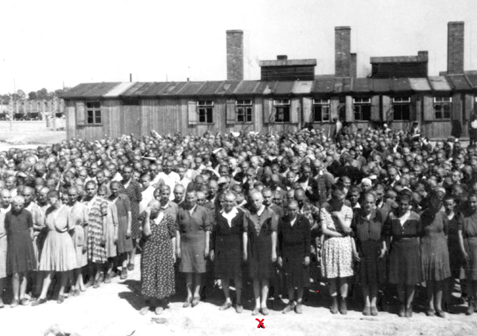
September 27, 1941: Karl Bischoff, chief architect of the future Birkenau camp, plans to build wooden barracks, each containing 62 bays, with each bay able to accommodate 4 prisoners: therefore, each barrack is intended to house 4 x 62 = 248 prisoners. However, given the rapid succession of prisoner transports, the SS crammed more prisoners into each barrack, resulting in increasingly degraded conditions. During periods of overcrowding at Birkenau, between 800 and 1,000 prisoners, instead of the initially planned 250, were housed in each barrack!
This first Birkenau camp (later designated B-I) is intended for a large number of Russian prisoners before it will later become the women's camp.
October 7, 1941: Arrival of nearly 10,000 Russian prisoners of war. They are initially housed in a section of Auschwitz camp separated by a wire fence. They are assigned to the construction of the new camp at Birkenau, which is intended to hold 100,000 prisoners of war. The building materials for this camp were bricks and wood sourced from nearby Polish villages that have been emptied of their inhabitants.
More than 1,000 of these prisoners of war are executed or die at work each month. By the spring of 1942, only a few hundred will survive. Because they are prisoners of war, normally protected by international conventions, the SS record various illnesses as the cause of death. These prisoners of war are the first to receive a registration number tattooed on their bodies (instead of a number on their clothing): this tattoo is specific to Auschwitz and Birkenau.
November 1941: Following complaints from regional commanders in Poland about the rate of Jewish deportations to the east, Himmler suspends deportations until the construction of new so-called "extermination" camps. These are the Belzec, Sobibor, and Treblinka camps. These camps are small in size because they are entirely designed for mass murder upon the arrival of the deportees. After intense use within a few months, these camps are dismantled. For its gas chambers, the Belzec camp will use carbon dioxide (CO2), as it is done in the experimental camp at Chelmno near Lodz. There the CO2 is produced by the smoke from exhaust pipes of trucks located next to the buildings. The first transport of victims will arrive at Belzec in March 1942.
November 11, 1941: Erection of the Wall of Death, or Black Wall, probably made of wooden railway sleepers painted black. This wall is located between Blocks 10 (Medical) and 11 (Gestapo prison). Prisoners are summarily executed by shooting. The SS officer in charge of these executions is Gerhard Palitzsch, and he even wants to carry them out personally. He will boast to another guard that he killed 25,000 people with a bullet to the back of the neck.
After the executions, the bodies are transported in carts to be cremated at the camp crematorium.
December 4, 1941: An expansion of Birkenau with two additional camps, B-II and B-III, is already being planned. The barracks would be prefabricated from wooden planks salvaged from local barns. These structures will arrive ready for use in the spring of 1942.
December 7, 1941: Surprise attack on Pearl Harbor by Japan. The USA immediately declared war on Japan, and Germany, Japan's ally, declared war on the USA on December 11, 1941.
December 11, 1941: Dr. Friedrich Entress arrives at Auschwitz, where he will conduct medical "experiments," paid for by Bayer, a pharmaceutical subsidiary of IG Farben, to do "research" on several diseases such as typhus and tuberculosis. He is barely 27 years old and will be considered one of the most cruel Nazi doctors in the camp. In Block 21, he injects diseases into healthy prisoners for his experiments. He treats the prisoners as mere material for his biological tests, without any compassion. Entress also sells women to Bayer as human guinea pigs, injected with diseases, to be tested in their laboratories in Germany. A letter from Bayer complained to Entress: The convoy of 150 women arrived in good condition. However, we were unable to obtain conclusive results as they died during the experiments. We would be grateful if you would send us another group of women, in the same number and at the same price. These women die during anesthesia. Each had cost Bayer 170 Reichsmarks. Bayer wanted to test Rutenol, a derivative of arsenic acid, against tuberculosis. This drug will prove ineffective but causes horrific suffering to the prisoners who receive it.
Entress will remain at his post at Auschwitz until October 20, 1943.
December 13, 1941: Following the entry of the USA into the war, which Hitler blames on "world Jewry," and calls for the acceleration of the Final Solution program. Initially, he had only requested their deportation to areas east of the Reich, although the plan to build extermination camps and the mass murder tests using CO2 at Chelmno prove otherwise. But now he openly demands their systematic extermination. In his diary, Goebbels wrote: Regarding the Jewish question, the Führer is determined to eradicate them completely. He had prophesied to the Jews that if they started another world war, they would suffer their own extermination. This was not an empty promise. The world war is here, and the extermination of the Jews is its inevitable consequence. This issue must be addressed without sentimentality.
Regarding the "prophecy" mentioned by Goebbels, it refers to a speech given by Hitler in the Reichstag on January 30, 1939, before the start of a war he himself instigated: Today I will once again be a prophet: if international Jewish finance, both in Germany and abroad, succeeds in plunging the nations into another world war, the result will not be the Bolshevization of the earth, and thus the victory of Judaism, but the annihilation of the Jewish race in Europe!
Hans Frank, head of the General Government in occupied Poland, based in Krakow, declares at a conference: As a former National Socialist (Nazi), I must state that if the Jewish community were to survive the war in Europe, while we are sacrificing our best blood for the defense of Europe, this war would only be a partial victory. Therefore, as far as the Jews are concerned, I assume they will disappear… We must exterminate the Jews wherever we find them.
December 18, 1941: Pragmatically, Himmler asks Hitler on what grounds the Jews should be exterminated. Hitler replies: "As partisans." For Hitler, a Jew, regardless of age, was an enemy of the Reich!
To advance to the next period in this Auschwitz timeline, click below.
Navigation >>> Timeline 1942
Albert Benhamou
Private tour guide in Israel
April 2026

Legends:
1- House of Commandant Rudolf Hoess and his family
2- Main guard building
3- Camp administration offices
4- Gestapo
5- New prisoner reception office
6- Kitchens
7- Gas chamber and crematorium oven
8- Warehouses and workshops
9- Storage of confiscated property (nicknamed "Kanada")
10- Gravel pit (execution site)
11- Orchestra pit near the camp entrance
12- The Wall of Death (also called the Black Wall) between Blocks 10 and 11
13- Block 11 (site of Gestapo atrocities and isolation bunkers)
14- Block 10 "Medical"
15- SS hospital


Comments