


Auschwitz timeline: 1944, first half
Before continuing this timeline of the history of the Auschwitz camp, please ensure you have read the previous timelines, starting with the period 1940-1941. To read them, click here. Here we continue the timeline for the first half of 1944.
Warning: Some accounts may be disturbing, so the reader should use their own judgment before continuing on this page.
January 1, 1944: Only 32 of the 188 barracks initially planned have been built so far in the new Camp B-III, also known as Mexico.
January 1, 1944: Daniel Obstbaum, a 35-year-old French Jewish prisoner and kapo for the SonderKommando, attempts to escape with four other prisoners. He thought he had bribed an SS officer named Dobrowolny, who promised to help him escape. The escape fails because the SS officer deceived them, and the five prisoners are shot.
January 16, 1944: Morgenthau, Secretary of the Treasury, denounces to Roosevelt the State Department personnel concerning the War Refugees Board: 1- for their complete failure to prevent the extermination of Jews in Europe; 2- for concealing their malicious intentions by creating fictitious organizations, such as intergovernmental organizations, to manage the refugee problem; 3- for suppressing for two months reports submitted to the State Department on German atrocities, after the publication of similar reports had intensified public pressure.
The Secretary of State's name was Cordell Hull. In 1939, he advised Roosevelt to deny entry to the US to the passengers of the St. Louis, a German ship carrying nearly 1,000 German Jews who had tried, in vain, to flee Nazi Germany. American Jewish organizations were already complaining in 1940 about the State Department under Hull regarding its policy toward the fate of the Jews.
February 21, 1944: Primo Levi, the famous Italian author, arrives at Auschwitz and is sent to the Monowitz camp. There, he is protected by an Italian bricklayer who brings him food rations to survive. Both are from Piedmont.
February 24, 1944: Following the escape attempt of January 1 with Daniel Obstbaum, 200 SK (SonderKommando) members are sent to the Majdanek camp, near Lublin, as crematorium "specialists." Upon arrival, they are shot and cremated. Birkenau's reason for proceeding in this way was to avoid alerting other members of the SK of their impending fate.
February 29, 1944: Adolf Eichmann visits Birkenau and also inspects the family camp for Jews from Theresienstadt. He tasks Fredy Hirsch with writing a report on the children's education there. However, as early as March 1, 1944, he orders the execution of all men, women, and children who had been in the camp for six months or more. On March 2, 1944, all those slated for deportation from Auschwitz are required to write to their loved ones, and their postcards are to be postdated March 25, 1944. They inform them of their transfer to a labor camp in Heidebreck, Upper Silesia. Thisi s all a deception.
The Polish resistance at Birkenau learns that the selected families are to be liquidated, and messages reached them urging them to revolt by setting fire to their wooden barracks. But these warnings are not taken seriously by the prisoners in the family camp. In any case, what can they do, with women, the elderly, and children, against armed SS guards who surround the camp on all sides?
March 8-9, 1944: Liquidation of selected families, those who had spent six months or more at Birkenau. These families are taken at night from their camp B-IIb and sent to the adjacent camp, B-IIa, the quarantine camp, with the information that they would be deported to the Heidebreck camp. But they are sent to the gas chamber. In total, nearly 3,800 people are gassed that night. Dr. Mengele obtains a dozen twins from the camp for his experiments.
The educator Fredy Hirsch, who suspected the SS of deception but was unable to stop it, commits suicide that same evening. That night is the eve of the Jewish holiday of Purim.
Before entering the gas chamber, seeing the prisoners hesitate, Peter Voss, head of all the crematoria, addresses them: So, what does all this mean, you Jews? Your time has come. Nothing in the world can change your fate. Everything rests on you: if you are reasonable, you can spare yourself and your children much suffering, great suffering! Everything will be much easier if you undress quickly and go into the next room. Or do you want to make your children's last moments needlessly painful?
According to the testimonies of SK members, the scenes that night are heartbreaking because the victims are fully aware of their fate, given their long months of existence in Birkenau. Despite the commotion and the blows from the SS, parents and children try to walk to their deaths together. Others address the SS guards with insults and prophecies of Nazi defeat.
Filip Muller, an SK member on duty at the crematorium that night, decides he wants to die and also enters the gas chamber in his striped prisoner's uniform. But a group of naked young women persuades him to leave and try to survive in order to bear witness. One of them, Yana, shows him a gold chain she wears around her neck. She asks him to retrieve it after their deaths and give it to her boyfriend, Sasha, a baker. Suddenly, an SS guard, Kurschuss, recognizes Muller in the gas chamber and drags him outside, shouting: You piece of trash! Get this through your thick head: we decide your life and death, not you! Now, get to the crematorium ovens!
Later, Muller takes the gold chain from Yana's body and gives it to Sasha, a Red Army non-commissioned officer, taken prisoner in 1941 along with approximately 13,000 other Soviet soldiers. By January 1945, fewer than 100 are still alive.
March 18, 1944: Hungary wants to withdraw from the war and its alliance with the Axis powers. German troops enter Hungary, and a new pro-German fascist government is installed. The situation leads Hungarian Jews, who until then had been spared by the war, to fear the worst. Elie Wiesel recounts the testimony of a traveler from Budapest: The Jews of Budapest live in a climate of fear and terror; anti-Semitic incidents are a daily occurrence, in the streets, on the trains; fascists attack Jewish businesses and synagogues; the situation is becoming very serious. [...] Barely three days have passed, and already German army vehicles have appeared in our streets.
At that time, there were 760,000 Jews in Hungary, representing approximately 5% of the population. Around 450,000 of them lived in regions outside of Budapest.
March 21, 1944: Although he almost never leaves his office in Berlin, Adolf Eichmann personally travels to Budapest, accompanied by his aide Wilisceny, to discuss the Final Solution and plans to deport Hungarian Jews to Birkenau.
March 23, 1944: At Birkenau, space has to be made quickly in anticipation of the massive influx of Hungarian Jews. The SS decides to liquidate Camp B-IIe, the Roma camp, to free up their barracks. This is the last liquidation of the Roma population of the camp, and some 4,200 are gassed.
March 24, 1944: President Roosevelt sends a statement to the press: One of the most heinous crimes in history—begun by the Nazis in peacetime and multiplied a hundredfold in wartime—is the systematic and widespread slaughter of the Jews of Europe, which continues unabated. All those who knowingly participate in the deportation of Jews to their deaths in Poland, or of Norwegians and French people to their deaths in Germany, are as guilty as the executioner. Those who share the guilt will share the punishment.
April 1944: Gisella Perl arrives at Birkenau. She is a Hungarian Jewish gynecologist who speaks several languages, including Hungarian, Romanian, German, French, and Yiddish.
When Mengele learns of her specialty, he assigns her the task of examining each pregnant woman and giving him a direct report. He tells her they would be sent to a special camp, where they would receive extra bread rations and even milk. She soon discovers the truth... She understands that these women were condemned to death. Therefore, she hides the pregnant women she finds and, if necessary, terminates their pregnancies, or discreetly induces labor and then kills the newborn. She would later explain: the child had to die so that the mother's life could be saved. This is how Perl performed her nighttime abortions at the risk of her own life.
April 1, 1944: Construction of Camp B-III, also known as Mexico, is halted. Only about sixty barracks were erected. The precarious situation of the Germans on the Eastern Front did not favor further development in the region.
April 5, 1944: Siegfried Lederer, a 40-year-old Czech Jew, escapes from Auschwitz wearing an SS uniform provided by 20-year-old SS guard, Viktor Pestek, who accompanies him out of the camp. Pestek, a devout Catholic, opposed the Holocaust and fell in love with Renée Neumann, a Jewish prisoner. After the successful escape, Pestek returns to Auschwitz to save Neumann. But he is arrested and tortured. He is later executed outside the camp on October 8, 1944. As for Lederer, he joins the Czech resistance and attempts to smuggle a report on Auschwitz to the International Committee of the Red Cross (ICRC) in Switzerland.
April 7, 1944: Two prisoners from Birkenau hide for three days in a pre-prepared area of the Mexico camp and escap during the night after the SS abandoned their search. They are Rudolf Vrba, 20 years old (real name Walter Rosenberg), and Alfred Wetzler, 26 years old. Both manage to reach Slovakia and survive the war. They carry with them a wealth of information about the camp's events, carefully gathered from several members of the SK (SonderKommando) during the planning of their escape. Thanks to Filip Müller, they even obtain precise details about the gas chambers and a label from a can of Zyklon B. Together, they write a 33-page report on the camp and submit it to the Jewish Council of Switzerland. The Allies subsequently receive this report, and newspapers report on it.
April 11, 1944: After a ten-day journey, a convoy arrives at Birkenau with 2,500 Greek Jews, 320 of whom are chosen to reinforce the SonderKommando (SK) commandos in preparation for the massive influx of Hungarian Jews. Among these new SK members are the brothers Maurice and Shlomo Venezia, aged 23 and 21 respectively. Both survive the war, and Shlomo Venezia wrote his memoirs.
Also on this convoy is Jacob Gabbai, aged 32, a cousin of the Venezia brothers. He describes the journey in his memoirs: Our convoy came from Athens. (...) The journey lasted ten days, from April 1 to 11, 1944. We crossed Greece, Yugoslavia, Hungary, and Austria, until we arrived in Poland. […] In the train carriage, there were no toilets, and we received rationed food. We tried to spend as much time as possible sleeping. During the eleven days, several of us died. The doors never opened, except once, when we arrived in Budapest. They opened the doors to give us water. At that stop, they also removed the dead from the carriages.
April 15, 1944: Simone Veil, the future French minister, arrives at Birkenau.
April 28, 1944: Henryk Mandelbaum arrives at Birkenau at the age of 21. He is selected to join the SonderKommando (SK). He survives the war and writes his memoirs.
April 29, 1944: The first convoy of Hungarian Jews arrives at Birkenau. It consists of 1,800 people. Their deportation initially signals the transport of approximately 450,000 Jews living in various regions of Hungary except Budapest.
April 30, 1944: Filip Muller recounts: Towards the end of April 1944, rumors of the imminent extermination of the Jews of Hungary were multiplying; for us, the SK prisoners, this terrible news was a devastating blow. […] Once again, we pressed the (Polish) resistance in the camp to give the signal for an uprising. However, they still refused to take any risks. Once again, we were deluded into believing that the advance of the Red Army would quickly demoralize and disorganize the SS. […] When we pointed out that this attitude meant nothing less than that we would once again be forced to cremate hundreds of thousands of people, we were given to understand that it was impossible to save them anyway.
May 1, 1944: The staff at Kanada is also reinforced due to the plan for massive arrival of Hungarian Jews whose personal belongings have to be confiscated. One prisoner, Kitty Hart-Moxon, is assigned to Kanada. From a window of one of these barracks, one could see what was happening at Crematorium IV, located just under 50 meters away. She recounts her first glimpse of this hell: Outside the low building (the crematorium), a ladder had been placed. A figure in an SS uniform climbed it briskly. Reaching the top, they put on a gas mask and gloves, poured what looked like a white powder into an opening in the roof, then hurriedly climbed back down the ladder and fled. Screams began to emanate from the building. We could hear them echoing all the way to our barracks. The desperate cries of people suffocating. I held my breath and covered my ears, but the screams were so loud it seemed as if the whole world could hear them. "It's over," someone said, shaking me. "Everything's all right, the silence has returned, they're all dead now." It couldn't have taken more than ten minutes. […] I continued to stare at the building. Smoke was beginning to billow from the tall chimneys. The black smoke grew thicker, darker, and more suffocating, carrying with it the stench of burnt grease, bones, and hair. And, as night fell, the entire sky appeared red. Smoke and flames billowed from every chimney. None of us slept a wink all night. (...) And day after day, we watched the procession toward the gas chambers and heard the screams. Day and night, we smelled the stench of the crematoria, which struggled to keep up with the increasing pace of the transports.
The rate of transports from Hungary increased significantly starting on May 15, 1944.
May 2, 1944: The Venezia brothers and their cousin Gabbai, after being selected as SK members and completing 20 days of quarantine, begin working in the crematorium ovens. Jacob Gabbai describes: My role was to collect the bodies and, with another prisoner, place them on a stretcher. Using a pitchfork, I had to push them directly into the oven. Each oven had three doors. Four bodies could be passed through each door—sixty bodies in fifteen minutes—and every fifteen minutes, everything had to be stirred with the pitchfork. The fire would intensify, and after another fifteen minutes, nothing remained of the victims but ashes, and the work would begin again from the start. Our work consisted of only three minutes, four at most, and a half-hour break. Newspapers in Greece were already reporting, in 1943, the atrocities committed by the Germans in the camps, but we didn't believe it. Who could believe that the Germans—a civilized people—were capable of such a thing? But every day Jews were burned, day after day, without end, and outside, the orchestra and the women's choir played and sang.
May 6, 1944: The pace of trains arriving at Birkenau becomes so frantic that managing this extermination operation required a suitable camp management experience. Rudolf Höss is immediately recalled to Auschwitz. His replacement is temporarily reassigned to command the Majdanek camp near Lublin. Höss has a new railway line built and a ramp into Birkenau to allow the SS to bring the prisoners as quickly as possible to the gas chambers. Previously, the trains had to stop about 3 kilometers from Birkenau, and the prisoners had to walk to the camp.
May 8, 1944: Upon returning to Auschwitz, Höss appoints Josef Kramer as commandant of Birkenau, Otto Moll as head of all crematoria, replacing Peter Voss, and Richard Baer as commandant of Auschwitz I.
May 13, 1944: In Germany, the media no longer conceal from the public what is happening to the Jews, perhaps to show them that this war, despite its military setbacks, had been a boon for Germany. An article in the Danziger Vorposten testifies to this: the Jewish population of Poland had been neutralized, and the same phenomenon was underway in Hungary; in these two countries alone, five million Jews had been eliminated.
Another example, taken from an article in Angriff (Goebbels's newspaper): Judas must perish to save humanity. Thus, the Nazi policy of exterminating the Jews is now widely known to Germans. The expression "you'll go through the chimney" becomes a proverb in Germany!
May 14, 1944: Eichmann visits Birkenau to observe the procedures in place to absorb the influx of Hungarian Jews slated for extermination. The female prisoners of Kanada can watch him from their barracks. Kitty recounts: He spent several hours in the camp, pacing the buildings, inspecting the gas chambers and crematoria. Eichmann was not one of those who wanted to keep prisoners alive to work in the factories. His sole obsession was to exterminate as many as possible, as quickly as possible. When he left the camp, the sense of horror he left behind was almost as real as the smoke and the smell of burning flesh.
May 15, 1944: The day after Eichmann's visit, large transports of Hungarian Jews begin to arrive. That day, a convoy of nearly 10,000 people arrives at Birkenau. This number per convoy became the norm for about six weeks, until the deportation of Hungarian Jews is halted. This date thus marks the official beginning of the operation that Eichmann named "Sonderaktion Ungarn" (Special Action in Hungary).
May 18, 1944: The incessant arrival of transports of Jews to be exterminated also means an improvement in conditions for the camp's prisoners. Smuggling resumes with the stolen goods and jewelry, and the SS guards are more concerned with enriching themselves than with doing their usual work. The Polish prisoner Kielar recounts: the Kanada commando was sweating on the ramp under the watchful eyes of a few SS men; they were carrying out a second sorting—that of the victims' belongings. Trucks loaded with suitcases, bags, and bundles were taken to the Kanada warehouses where a more rigorous sorting took place. Much of the loot, especially food and valuables, made its way to the camp by circuitous routes. The camp was experiencing a new period of abundance. (…) The camp had enough to eat. The camp breathed easier, because the drunken SS guards were too busy with transportation to pay any attention to the prisoners. They searched for gold and stuffed their pockets with it, anxious to secure their future. The prisoners at Kanada did the same: they needed these jewels to ease their existence. At the camp, on SS orders, members of the SonderKommando (SK) even went so far as to sift through human ashes to find diamonds. The gold from crowns and bridges was melted down into ingots, which were sent to the Reich to replenish the coffers of a state on the verge of collapse. The other human remains were scattered in the fields or ponds. Only human fat was wasted because, at Auschwitz, they didn't make soap.
May-June 1944: Filip Muller describes Moll as follows: Otto Moll was nicknamed "Cyplops" because of his glass eye. He was a cruel, brutal, unscrupulous, and unpredictable monster, sadistic, insensitive, and bloodthirsty, driven by a thirst for killing. Shortly after his arrival, Moll ordered five pits to be dug behind Crematorium V. In addition, four crematorium pits were dug outside one of the restored farmhouses (Bunker 2). Changing rooms (for undressing before gassing) were set up in three wooden barracks, and the entire complex (of Moll's) was known as "Bunker 5." There were now nine of these large pits, in addition to the crematorium ovens, allowing for the incineration of a virtually unlimited number of corpses. All these facilities were the brainchild of the mass murderer Moll, who had managed to transform a small corner of the earth's surface into a place of such abjection that it made Dante's Inferno seem like a pleasure garden. […] The ashes of the cremated bodies were thrown into fish ponds or the Vistula River. In this context, Moll devised a new technique to expedite the removal of the ashes: he had an area approximately 60 meters by 15 meters, adjacent to the pits of Crematorium V, paved over with concrete. On this surface, the ashes were ground into a fine powder before their final disposal.
In addition to the cremation pits, Moll has trenches or ditches dug around them to collect the human fat that seeps from the cremated bodies. Filip Muller recounts in this regard: One day, Moll snatched a child from its mother. I saw it at Crematorium IV. There were two enormous pits where the corpses were cremated. He threw the child into the boiling fat that had accumulated in the ditches around the pit, then said to his assistant, "Now I'll eat my fill; now I've done my duty." Another way Moll satisfied his perverse thirst for murder was by killing young children, throwing them alive into boiling human fat in front of the pits. When the camp commandant or other SS commanders arrived at the crematorium site, Moll would restrain himself and suppress his abnormal impulses. Then the killing machine would resume its usual, impersonal course, without any excesses.
Here is another account of Moll's cruelty. Alter Feinsilber, a member of the SK, recounts: Moll ordered a naked woman to sit on the corpses near a pit, ordering her to jump and sing, while he shot the prisoners and threw them into the pyre. Of course, she obeyed, hoping to save her life. After executing everyone, Moll shot this woman, and she was cremated.
Moll's character is confirmed by Dr. Miklos Nyizli, a Jewish prisoner in charge of dissections under Mengele's authority: Moll was responsible for these murders. As a doctor and eyewitness, I swear he was the most despicable, diabolical, and hardened murderer of the Third Reich. […] Here, (with only a single shot fired), most of the individuals were thrown alive into the flames. […] When the two pyres operated simultaneously, the output varied from 5,000 to 6,000 deaths per day, slightly higher than that of a crematorium; but here, death was a thousand times more terrible, for one died twice: first from a bullet to the back of the neck, then by fire. After death by gas, by phenol injection, and by a bullet to the back of the neck, I was now discovering this fourth method.
May 22, 1944: arrival of the Czech Jew David Herman at Birkenau. He recounts the selection: As they ordered us to get off the train, several SonderKommandos whispered things to us in Yiddish, and one of them said to me in a low voice: "Tell them you are 18 years old and that you have a profession." I was perplexed by what he was saying about my age, but I eventually understood. Although I looked young for my 17 years, I said I was 18 and that I was a carpenter. The SS officer gestured with his cane and indicated that I should stand in a corner. I obeyed.
May 23, 1944: with 250 new arrivals from a transport of Greek Jews, the SK commando unit now holds 900 members from Germany, Poland, Greece, the Netherlands, France, Slovakia, and Hungary.
May 24, 1944: Himmler's speech to German generals: Another question, crucial to the internal security of the Reich and Europe, was the Jewish question. It was resolved without compromise, following orders given and rational analysis. Gentlemen, I believe you know me well enough to know that I am not a bloodthirsty man. I am not a man who takes pleasure in committing brutal acts. However, I also have strong nerves and a very keen sense of duty [...], so that when I judge an action necessary, I can carry it out without compromise. I did not feel entitled—this particularly concerns Jewish women and children—to allow these children to grow up and become the avengers who will later murder our children and grandchildren. That would have been cowardly. Therefore, the matter was resolved without compromise.
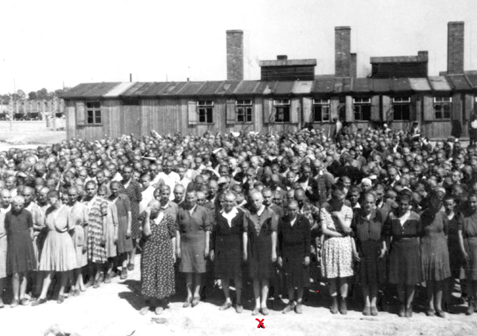
May 26, 1944: SS photographers arrive at Birkenau to document the extermination of Hungarian Jews. Their photos are obviously not released publicly but are compiled in an album discovered after the war. Lili Jacob, one of the people photographed, recognizes herself in one of the photos, as well as the rest of her family, who were exterminated on the day of their arrival.
May 27, 1944: Vrba and Wetzler's report from the previous month is supplemented by another report following the escape of two more prisoners, Czeslaw Mordowicz and Arnošt Rosin, on that date. They reach Slovakia on June 6. These escapes reveal the already underway extermination of Hungarian Jews. When the world receives this latest report, international pressure forces Hungary to halt the deportation of its Jewish citizens.
However, despite these detailed reports of what is happening at Birkenau, no military action is taken by the Allies, such as bombing the Auschwitz train station through which all the deportation trains pass. In the camp, the prisoners who help these escapes do not see the hoped-for international aid arriving and believe that they are abandoned to their fate, or even betrayed.
May 30, 1944: a transport from Sighet, Transylvania, arrives during the night with 15-year-old Elie Wiesel and his family. Mengele carries out the selection: Elie and his father are to be killed and are led toward the burning pits in the small woods of Birkenau... Elie Wiesel recounts: Not far from us, flames were leaping from a ditch, gigantic flames. They were burning something. A truck stopped at the edge of the pit and unloaded its cargo: small children, babies! Yes, I saw it, I saw it with my own eyes… those children in the flames (is it any wonder I couldn't sleep after that? Sleep had abandoned me). So that's where we were going. A little further on was another, larger ditch, for the adults. […] How was it possible to burn people, children, and for the world to remain silent? […] We continued our march; We were slowly approaching the ditch from which an infernal heat rose. Twenty more paces to go. If I wanted to bring about my own death, now was the time. We only had fifteen paces left to cover. I bit my lip so my father wouldn't hear my teeth chattering. Ten paces. Eight. Seven. We walked slowly, as if we were following a hearse to our own funeral; four more paces; three. There, right in front of us, stood the pit and its flames. I mustered my last bit of strength to break free from the ranks and throw myself onto the barbed wire. Deep in my heart, I bid farewell to my father, to the entire universe, and despite myself, the words formed of their own accord and escaped my lips in a whisper: "Yitgadal veyitkadash shmei raba"... May His name be blessed and glorified... My heart overflowed. The moment had come. I was face to face with the Angel of Death. No. Just a few steps from the pit, we were ordered to turn left and be led into a barracks. I squeezed my father's hand.
Elie Wiesel and his father are spared at the last minute because orders are given to send deportees to a forced labor camp.
May 29, 1944: arrival of Miklos Nyiszli, a 43-year-old Hungarian Jew, a pathologist by profession. He had studied medicine in Germany and therefore spoke the language perfectly. Mengele kept aside any medical personnel who might be useful to him. Miklos is given an office and a dissection room in Crematorium II. It is his memoir, published shortly after the war, that brought Mengele to public attention. Mengele appreciates the doctor's competence and protects him. He even allows him to see his wife and daughter in the women's camp and, with Miklos's consent, arranges to send them to another labor camp to save them from sure death at Birkenau.
May 31, 1944: Dr. Pasche, a Frenchman in the SK commando, begins keeping a tally of the number of deaths at Birkenau. For May 1944 alone, he counted 360,000 deaths, even though the high rate of Hungarian Jewish deaths had only begun about two weeks earlier.
June 1, 1944: Due to the large number of deportees from Hungary, Hungarian Jewish women selected for forced labor are housed in the unfinished B-III camp (Mexico City), despite the camp lacking running water and other basic amenities.
June 6, 1944: The Allied landings in Normandy occurs while the Red Army is only a few hundred kilometers from Budapest. Despite these German setbacks and the inevitable end of the Reich, the German death machine continues to gas and burn the Jews of Europe.
June 9, 1944: In the camps, the prisoners learn of the Allied landings. The fear is that the Nazis will dispose of all incriminating evidence about the death camps and exterminate all the survivors. The idea of an uprising regains momentum among the approximately 900 members of the SK (SonderKommando) as they are strong and healthy. The Polish resistance within the camp seems willing to cooperate. According to Filip Muller, the date of their revolt is set for Friday, June 16, 1944. Their plan is to kill the few SS guards assigned to the crematoria, seize their weapons, blow up the crematoria with improvised explosive devices, and escape en masse from the camp before German reinforcements arrive. This is what was accomplished at the Sobibor camp!
June 12, 1944: The last Greek Jews are deported. These are approximately 2,000 people Jews from Corfu, of whom only a small number would survive.
June 16, 1944: General Oswald Pohl comes to inspect the camp, guided by Rudolf Höss. A large number of German officials accompanies them. It was the planned day of the uprising! Consequently, the Polish resistance sent a counter-order to the SK members to postpone the operation. Disappointment reigns in the crematoria, as escape is the only hope of survival for the SK members.
June 18, 1944: The BBC in London broadcasts some information about what it called "the Auschwitz protocols." These are excerpts from the Vrba-Wetzler report, which is now circulating in various countries. It is perhaps for this reason, and following an internal investigation into the causes of the leak, that the Nazis suspends the transports of Hungarian Jews that day, but they resume them on June 28.
June 20, 1944: The reduced frequency of transports of Hungarian Jews causes a change in attitude among the SS guards at Birkenau. Kielar recounts: There couldn't have been many Jews left in Hungary because the transports were becoming less frequent and less numerous. The ramp was deserted. The SS then remembered the camp and made increasingly frequent raids. The block commanders were in a frenzy and searched entire blocks: that's where they were looking for gold now. The kapos and block leaders stopped flirting with Hans (the Jewish kapo in charge of Kanada), and Jupp (nicknamed after a German kapo, Josef Windeck, a former criminal and cruel to prisoners, who arrived at Auschwitz as early as 1940) forgot that just a short time before they had been strolling arm in arm, like old friends. Ha! One day, he even proved his friendship by searching him. Furious at finding nothing, he slapped him across the face: "Here, take this, you filthy Jew!" Kanada had ceased to exist, along with half a million human beings.
The fate of the prisoners in Kanada and in the crematoria becomes precarious in the eyes of those concerned, who suspect that the decrease in "activity" would inevitably lead to a reduction in numbers through the elimination of many of them. As a result, plans for individual escapes increase and are carried out. This is the case of a young couple, the Polish prisoner Edek and his Jewish girlfriend Mala, who set their escape date for Saturday, June 24. Kielar, a longtime friend of Edek, is supposed to escape with them but backs out.
June 22, 1944: The Red Army launches a major offensive, Operation Bagration, on a front of nearly 800 km from the Baltic to the Caspian Sea. The German army is largely defeated with the collapse of its central corps. In 23 days, the Red Army advances some 400 km westward and arrives opposite Warsaw, on the other bank of the Vistula River.
June 23, 1944: The Nazis begin liquidating the last ghetto in Poland, the Łódź ghetto. It had been the first to be opened and the last to be liquidated. Its longevity was due to the number of German factories that used Jewish labor from the ghetto.
June 24, 1944: Edward "Edek" Galinski and Mala Zimetbaum (19 years old) successfully escape in broad daylight around noon. The young Jewish woman is weak due to malaria and hesitates until the last moment, but Edek finally convinces her to go with him. The SS guards only realize they had disappeared from the camp during the evening roll call. They stop near the border on July 7 because Mala is exhausted. They are then spotted and taken back to Birkenau. After interrogation to uncover any accomplices, they are sentenced to death, and the sentence is carried out on August 22, 1944.
June 24, 1944: Following public revelations about Auschwitz, Jacob Rosenheim of the Agudat Israel World Organization contacts the War Refugee Board in Washington to plead with the Allies to bomb the railway lines leading to Auschwitz. His request is forwarded six days later to John McCloy, Assistant Secretary of State for War, who is in charge of sabotage operations against the Nazi regime.
June 25, 1944: Pope Pius XII sends a telegram to Horthy, head of the Hungarian government, ordering him to halt the deportation of Jews after the Vatican received a copy of the Vrba-Wetzler report in May 1944.
June 26, 1944: Allied reconnaissance aircraft flies over the Auschwitz-Birkenau complex and takes photographs. Unfortunately, at that time, the crematoria are not in operation, so no smoke is visible in the pictures, and the camp ramp is empty of any transports. It looks more like a labor camp than a mass extermination camp.
June 28, 1944: after a 10-day pause, the transports of Hungarian Jews resume their regular schedule.
June 29, 1944: The first convoy of Greek Jews from Corfu arrives at Birkenau. Most are gassed upon arrival.
June 30, 1944: given the ongoing work of the SK commandos, Otto Moll decides to house a large number of them not in the men's section of Camp B-IId, but in the attic space of Crematoria II and III, where he has dormitories set up. Those SK members working at Crematorium V are housed in Crematorium IV, which is not operational at this time due to a breakdown. In fact, after some time, all SK members are housed in Crematoria II, III, and IV. Some SK members, knowing the cunning Moll well, believe he made this change to more easily liquidate groups of SK members already in the crematoria.
June 30, 1944: Dr. Pasche, a Frenchman with the SK commando, continues to record the number of dead at Birkenau. For May 1944, he had counted 360,000 dead. For June 1944, he counted 512,000 dead, primarily Hungarian Jews.
To return to the previous timeline or advance to the next, click below.
Timeline 1943 <<< Navigation >>> Timeline July-December 1944
Albert Benhamou
Private tour guide in Israel
May 2026


Comments