


Auschwitz timeline: 1943
Updated: Jul 19
Before continuing with this timeline of the history of the Auschwitz camp, please ensure you have read the previous timelines, starting with the period 1940-1941. To read it, click here. Here we continue the timeline for the year 1943.
January 1, 1943: Dr. Josef Klehr becomes head of the "disinfection" team, a euphemism for the team responsible for injecting Zyklon B into the gas chambers at Birkenau.
January 11, 1943: A German telegram is intercepted by the British. It was sent by Hermann Holfe to Franz Heim. Its contents are an account of the number of Jews killed in 1942 during Operation Reinhard in the extermination camps in Poland: 1,274,166 people, including 24,733 at Majdanek (near Lublin), 101,370 at Sobibor, 434,508 at Belzec, and 713,555 at Treblinka. Treblinka was the largest extermination center of the Nazi state in 1942: it was the camp where the Jews of Warsaw were exterminated. It is therefore established that the Allies could no longer have any doubt by early 1943 about the extermination of Jews on the European continent. In terms of numbers, Auschwitz was still far behind, but this would not last.
January 27, 1943: A group of 230 French female resistance fighters arrived at Birkenau, including Charlotte Delbo, who, like 49 others, would survive the war. Also among them was Dr. Adélaïde Hautval, who would be employed in the sterilization department of Jewish women under Dr. Eduard Wirths, the chief physician at Auschwitz.
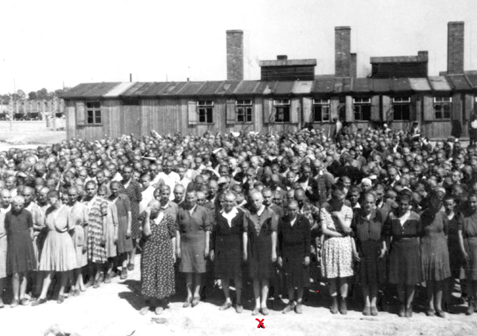
These 230 women were part of a convoy of approximately 1,000 men that arrived that evening at the Auschwitz train station. The following morning, the women were marched to the women's camp B-Ia at Birkenau, where they entered singing La Marseillaise! They were tattooed with registration numbers between 31625 and 31854, giving their group the name "Convoy of the 31000." Upon arrival, like all other prisoners destined for forced labor, they had to abandon their clothes and other personal belongings, shower in a building nicknamed "the Sauna," shave their heads, receive striped prison uniforms, and have their prisoner numbers tattooed on their arms. They were then taken to a quarantine barracks for two weeks. Finally, they were assigned to a specific women's work detail for forced labor. Their convoy was the only convoy of French female resistance fighters sent to Auschwitz.
February 2, 1943: The German army surrendered at Stalingrad. The year 1943 marked the decline of the Reich, with defeats in Russia and North Africa.
February 10, 1943: The German defeat at Stalingrad left a bitter taste in the mouths of the Nazi staff at Birkenau. They organized a "race" for the prisoners. The women had to stand all day in the snow and then run in front of the Nazi guards and doctors. This was a way of "selecting" them, keeping only those who survived this ordeal. Of the 230 French resistance fighters who had just been released from quarantine, 14 died that day. The rest were housed in Barrack 26 of Camp B-Ia and assigned to forced labor details starting on February 12, 1943.
February 12, 1943: Following the German telegram intercepted in January, President Roosevelt announced that the Nazis responsible for managing the camps would be prosecuted by American justice after the war. This decision was approved by the US Congress on March 18.
February 26, 1943: The first Roma and Sinti arrived at Birkenau following Himmler's directive in late 1942 to deport this category of people, even those of German nationality. But deportation did not mean extermination. For Hitler and Himmler, the goal was to separate them from the "pure" Aryan race. Therefore, upon arrival, they were housed in a specially prepared camp, B-IIe, without selection, without forced labor, and allowed to remain with their families in their civilian clothes. But ultimately, Nazi Germany wanted to get rid of them, and so they were simply "herded" into this camp, with limited resources such as food and other necessities. A significant number died "naturally" from hunger, disease, and other causes. This camp was eventually liquidated, along with those who survived, on August 2, 1944. In total, 23,000 Roma were sent to Birkenau.
February 27, 1943: Germany rounds up its last Jews, approximately 12,000 people, who were still employed in various factories. They are deported directly to Treblinka, except for a few privileged individuals who are sent to the Theresienstadt model camp.
February 28, 1943: A general roll call is held at the Auschwitz and Birkenau camps, where Nazi doctors select the sick and weak from among all the work details and send them to their deaths. The selection takes place outdoors, and the prisoners must undress completely in the freezing cold. All those selected are kept (naked) in blocks or barracks awaiting gassing. Sometimes this wait lasts a day or even longer. When it is time to go to the gas chambers in Bunkers 1 and 2, the prisoners are loaded naked onto the tipper bodies of trucks and taken to their deaths. Upon arriving at the gas chambers, the skips were lifted and the prisoners fell in piles onto the frozen ground. In this way, more than 1,000 women from the women's section B-Ia were selected for gassing. Those too weak to walk were carried to the gas chambers by members of the SK (SonderKommando). All the prisoners knew perfectly well what awaited them, but their weakened state led them to resign themselves to this fate, which would free them from their torment.
Similar scenes occurred at each execution of the selected prisoners. According to the SK's testimony, these were their worst moments, as they were ashamed of being strong, clean, and well-dressed, while the victims of the selection were emaciated, infested with lice, and filthy.
March 1943: The clandestine radio station of the Polish resistance at Auschwitz announces that, so far, the number of victims at the camp is 65,000 Poles, 26,000 Russian prisoners of war, and 520,000 Jews.
March 2, 1943: Goebbels writes in his diary: We are so deeply involved in the Jewish question that it would now be impossible for us to withdraw from it; a movement and a people who have severed ties with the past can fight with more energy (experience proves this) than those who still have a possibility of returning.
March 4, 1943: A convoy arrives from France, including David Olere, a highly talented draftsman. He is assigned to the SonderKommando (SK) unit at Birkenau and has left behind numerous sketches of the horrors he witnessed. He initially works at Bunker 2, then is assigned to Crematorium III when it becomes operational in June 1943. Olere is appreciated by the SS guards for his talent as an illustrator: they often give him their personal letters to illustrate with drawings. Olere survived the war.
March 15, 1943: During the first two weeks of March, numerous transports leave Auschwitz and Birkenau for other camps. They are mostly composed of Poles.
March 20, 1943: The first transport of Jews deported from Macedonia and Greece arrives at Auschwitz from Thessaloniki. The journey in cattle cars lasted several days, and most of the deportees arrive in a pitiful state, unfit for forced labor: almost all of them are gassed upon arrival.
March 22, 1943: The first crematorium at Birkenau, named Crematorium II (since Crematorium I was located at Auschwitz I), is inaugurated in the presence of Nazi officials, including Hans Frank, head of the General Government based in Krakow. Crematorium III, adjacent to Crematorium II, becomes operational in June 1943. Two other crematoria, IV and V, located further apart, are also inaugurated in the same year.
March 22, 1943: Yaacov Silberberg, a Polish Jew who had recently arrived in late 1942, is assigned to the SonderKommando (SK) at Birkenau to cremate the bodies in the new Crematorium II. At the beginning of this task, he does not think he could overcome his disgust and contemplates suicide. However, another comrade helps him overcome his feelings. Silberberg would later testify: I became completely indifferent [to the corpses]. You lose your capacity to feel. The bodies no longer had any value in my eyes. Little by little, I ceased to feel any human emotions toward them. I no longer perceived them as I would have with human bodies. Sometimes they were covered in blood and excrement. You get so used to such sights that, during breaks or when people were hungry, they would sit on them and eat [...] as if it were another world.
March 25, 1943: The Polish prisoner Kielar continues his account: Spring arrived. A typical Birkenau spring. The melting snow, not being absorbed by the clay soil, formed huge puddles. It was terribly tiring to walk in the thick, sticky mud. After having the blocks repaired, ‘Papa’ (Kapo Bienacek) started on the courtyard. He hired many Greeks for this work. They were like lost souls in the camp, careful to hide from the kapos who took particular pleasure in persecuting and mistreating them abominably. They much preferred to be with "Papa," who was demanding when it came to work but never used the stick he was always with. Soon it was possible to cross the courtyard without getting their feet wet, and at the foot of the wall, the beginnings of a future garden took root. (...) The large rats, even in broad daylight, came and went as they pleased in the courtyard. They were full of meat (flesh from corpses), but the (stale) cake was a treat for them.
March 30, 1943: At the end of March 1943, the first deportees from Bulgaria arrive at Auschwitz, numbering 13,000 Jews.
April 1, 1943: Sterilization experiments begin in the infamous Block 10, reserved for women, at Auschwitz I. A well-equipped research laboratory is set up there. Dr. Carl Clauberg, who arrived in December 1942, has access to a state-of-the-art X-ray machine, as well as four special rooms, including a darkroom for developing X-rays. A dormitory capable of accommodating up to 400 patients is also established on the first floor. Gradually, three pavilions are created within Block 10. One is reserved for Dr. Clauberg, another for Dr. Horst Schumann and Chief Physician Eduard Wirths, and the third houses the laboratory of the Central Institute of Hygiene in Berlin, which supports this initiative. The windows of Block 10 overlooking the inner courtyard, between Blocks 10 and 11, are boarded up so that the "patients" cannot witness the execution of prisoners.
The Polish resistance inside the camp sends a secret message outside the camp indicating that Block 10 is being used for experiments on castration, sterilization, and artificial insemination.
April 4, 1943: With the gradual implementation of the new crematoria, it is decided to demolish Bunkers 1 and 2. However, Bunker 2 is ultimately preserved. It should be noted that the bunkers were simply gas chambers, without cemeteries. As for the SK commandos from the bunkers, approximately 300 prisoners, they are kept alive due to their experience in the tasks assigned to them. They are to be employed in the new crematoria. They know, however, that their lives hang by a thread, as the Nazis have no intention of preserving living witnesses to their mass murders.
April 10, 1943: Of the 230 French female resistance fighters who were part of the convoy of 31,000, only 70 are still alive on this date, after less than three months, due to the harshness of forced labor and typhus.
April 19, 1943: Kornherr of the Berlin Statistical Office sends a report to Himmler indicating that, from 1933 to the present day, the European Jewish population has been reduced by half. Given that there were 6.5 million Jews in Europe, excluding the 3 million in the USSR, this corresponds to the murder of more than 3 million Jews to date: the vast majority being Polish Jews, whose population numbered 3.3 million before the war.
April 19, 1943: Bermuda Conference between the United States and the United Kingdom. It concerns Jewish refugees who had been liberated and those who had not yet been. The only agreement reached wi the necessity of winning the war against the Nazis. American immigration quotas are not increased, and the British prohibition (in their "White Paper") against European Jews seeking refuge in Mandatory Palestine remains in place.
April 20, 1943: On Hitler's birthday, Dr. Josef Klehr, who administers phenol injections to sick prisoners at Auschwitz I, is awarded the War Merit Cross.
April 26, 1943: During the night of 26-27 April, Witold Pilecki and other members of the Polish resistance at Auschwitz (ZOW) manage to escape. Several of them are eventually recaptured by the SS, but Pilecki escapes to Warsaw, where he later participate in the Polish uprising of 1944. Meanwhile, after his escape, Pilecki wrote a more detailed report about Auschwitz and the mass extermination of the Jews which started around the middle of 1942. This "Pilecki's Report" preceded the reports of later escapees and was passed to London and US governemnts. But no action was taken by the Allies. A prominent Polish historian, Jacek Pawłowicz, and expert on Pilecki, commented: We can only assume the British thought we were exagerrating.
May 1943: British MP Eleanor Rathbone publishes a pamphlet, *Rescue the Perishing*, denouncing her government's inaction in combating the extermination of European Jews.
May 25, 1943: 1,035 Roma prisoners from Camp B-IIe are liquidated due to a typhus epidemic spreading through their camp.
May 30, 1943: Dr. Josef Mengele, 32, arrives at Birkenau. Chief physician Eduard Wirths assigns him command of Camp B-IIe, the Roma camp, which is then suffering from the risk of an epidemic. This handsome and extremely elegant SS officer, with his engaging demeanor and refined politeness, gives the impression of a gentle and cultured man who has nothing to do with selections, phenol, or Zyklon B. The camp prisoners soon learn what lay behind this facade. But Mengele is primarily interested in the children, as he embarks on a study of twins in order to find a way to increase the fertility of German women.
Kielar testified: His behavior toward the children was schizophrenic in nature, for he was capable of great kindness, to the point of making them like him, bringing them sugar, caring about the small details of their daily lives, and doing things we would sincerely admire… And then, right after… the smoke from the crematoria, and these children, tomorrow or in half an hour, he would send them there.
This testimony is also confirmed by Vera Alexander, a barrack kapo with Roma children: Mengele came to the camp every day – he brought chocolate… When I scolded the children, they usually replied: "We'll tell Uncle you're naughty." Mengele was the good uncle. Vera Alexander, however, testified to how children were brought back to the barracks screaming in pain after a visit to their "dear uncle."
Mengele also participate in the selections, even when not assigned to them, hoping to find subjects for his experiments, including twins. Later, he also becomes an SS doctor overseeing the use of Zyklon B in the gas chambers of Crematoria IV and V.

June 7, 1943: Dr. Carl Clauberg's report to Himmler on his experiments sterilizing Jewish women: The method I have invented for the non-surgical sterilization of the female body is almost perfected. It consists of an intrauterine injection and can be administered by virtually any doctor capable of performing a gynecological examination. His inhumane method consisted of injections through the uterus into the fallopian tubes, effectively blocking them! As Clauberg is proud of his "scientific advances," he publishes his results in medical journals, undoubtedly hoping to establish a reputation in medicine!
June 30, 1943: Around mid-1943, significant changes occur following the German army's setbacks on the Eastern Front. First, summary executions of prisoners ceased, as labor is now essential to the German war effort, and the Auschwitz area contributes significantly. Prisoners then die solely from exhaustion due to the arduous work and a daily ration of only 1200 calories. Second, and for the same reason, non-Jewish prisoners are transferred to other labor camps in Germany, such as Buchenwald, resulting in a thinning of the camp's non-Jewish hierarchy. Thus, with the camp containing a large number of Jewish prisoners and, conversely, an insufficient number of non-Jewish prisoners, the kapos and block leaders are now chosen from among the Jews themselves.
July 1943: SS Judge Konrad Morgen, 33 years old, is tasked by Himmler with investigating corruption in the camps. Displeased with the looting of victims' belongings by SS officers, particularly gold, Himmler orders that all property stolen from Jews be handed over to the Reich. But of course, all the camps have their own system for trafficking in victims' property (especially valuables and gold from teeth), which ultimately enrich the SS guards and their entire hierarchy. Morgen begins his investigation in the camps in Germany: Dachau, Sachsenhausen, and Buchenwald.
July 5, 1943: The Battle of Kursk, lasting several weeks, spells the end for the Reich's armies on the Eastern Front, with 200,000 German soldiers killed in action. The Russian advance from the Baltic to the Caspian Sea is now unstoppable.
July 7, 1943: Allied troops land in Sicily. The Western Front is open on the continent, and the Allied advance will continue in Italy.
July 12, 1943: Sector B-Ib of Birkenau, which was occupied by male prisoners, becomes a sector for female prisoners, extending from sector B-Ia. The male prisoners are now in sector B-IId, known as the "men's camp."
Around the same time, construction begins on camp B-III, nicknamed "Mexico" (because it signifies a place far removed from the rest of camps B-I and B-II). This construction will never be fully completed, in terms of infrastructure and amenities, and will cease less than a year later, in April 1944.
July 18, 1943: Alma Rosé arrives at Auschwitz I. She is a renowned violinist in Austria, but Jewish and the niece of the composer Gustav Mahler. She is transferred shortly afterward to Birkenau to conduct the women's orchestra. This is a position she holds until her death from a sudden illness, likely poisoning or meningitis, on April 5, 1944.
July 19, 1943: Cremation operations at Auschwitz I are discontinued. From then on, cremations are only carried out at Birkenau in the new crematoria. The SK members from Auschwitz I are transferred to the SK commandos at Birkenau: these consist of two Polish prisoners and six Jewish prisoners. The SK commandos are housed in Block 13 in the men's camp B-IId, but they are separated from the other prisoners in this camp by a wall.
July 27, 1943: The first Allied bombing raids on Germany: Hamburg is targeted for a week. The decline of the Reich continues.
August 2, 1943: Eighty-six Jewish prisoners from Auschwitz, men and women, are transferred alive, with Himmler's approval, to the Struthof concentration camp (the only concentration camp in France), at the request of Dr. August Hirt, the camp doctor, to add to his "collection" of Jewish skulls for research purposes. They are murdered at Struthof under Hirt's orders.
August 18, 1943: The last transport of Greek Jews arrives at Birkenau. A total of 19 transports were organized to deport approximately 46,000 Greek Jews.
August 20, 1943: Filip Muller, a survivor and former member of the SK, recounted after the war: When a transport arrived from Bialystok, a SK member recognized the wife of one of his friends among the arrivals. In the crematorium's changing room, he bluntly told her they would all be gassed and then cremated. The young woman believed him. After a moment, realizing the gravity of his words, she began to tremble all over, then tore at her hair, beat her chest, and scratched her face. In a few minutes, she had managed to disfigure herself completely. Her face covered in blood, half-naked, and foaming at the mouth, she ran from woman to woman, breathlessly repeating what she had learned. Her words were so terrible that the women immediately looked away. Since no one was paying her any attention, she ran toward the area where the men were undressing. She pushed her way through the crowd and cried out, her voice trembling: "Believe me, they want to gas and cremate us; believe me, they're going to gas and cremate us all." But the men, busy undressing, paid little attention to this hysterical outburst. Before they had time to listen to her, she had already disappeared. (...) The entire group was gassed, except for the hysterical woman, who was interrogated under torture in a room adjoining the gas chamber to find out who had informed her of the gassing. She pointed to the friend who had told her. While she was being shot, SS men tied up the SK member, then Voss (Peter Voss, head of the four crematoria) and Kurschuss (his assistant) led him to one of the crematorium ovens. He was pushed inside and burned alive.
September 1943: Judge Konrad Morgen arrives at Treblinka, where he meets the camp commandant, Christian Wirth. Wirth informs him that thousands of Jews are gassed every week and that these massacres are carried out on Himmler's explicit orders. The immense piles of watches and foreign currency are enough to convince the judge of the commandant's account. At the end of the interview, Wirth suggests that the judge would investigate an extermination camp located near Auschwitz, run by a certain Rudolph Höss, whom Wirth describes as Himmler's talentless disciple! The judge, however, has no reason to investigate Auschwitz until, probably in October 1943, Berlin customs intercept a package containing 2 kg of dental gold sent by a doctor from Auschwitz to his family in Germany.
September 3, 1943: The head of the Boyan Hasidic dynasty and his followers arrive at Birkenau to be gassed. A member of the SK commando, Leib Langfus, recounted: This convoy included several important figures, among them the Rebbe of Boyan, Reb Moshe Friedman. He was one of Poland's most renowned scholars. Turning to the commanding SS officer, he proclaimed aloud in German: "Cruel murderers! Do not believe you can annihilate the Jewish people. The Jewish people will exist forever, but you, vile murderers, will receive your punishment. The innocent blood you shed will avenge you. Our innocent blood will know no rest until it has exterminated you all." The Rebbe of Boyan spoke with great fervor, and when he had finished, he exclaimed in a passionate voice: "Shema Yisrael!" All those accompanying him joined him in shouting "Shema Yisrael!" These few moments of true spirituality demonstrated that the eternal spiritual strength of the Jewish people will never be defeated.
September 3, 1943: On the same day as the gassing of the Boyan dynasty, Allied troops arrive in Italy. Mussolini falls on September 5, and the Italian provisional government signs the armistice on September 8, which leads to the German invasion of Italy in an attempt to counter the Allied advance.
September 8, 1943: The first convoy of Jews sent from the Theresienstadt model camp arrives at Birkenau. Camp B-IIb, designated for "families," is assigned to them. Like the Roma, they undergo no selection upon arrival, keep their clothing and personal belongings, and live with their families. The difference with the Roma camp is that here, women and men are separated into different blocks (undoubtedly due to a Nazi concern to prevent the mating and reproduction of Jews). According to a witness, Ruth Elias, drunken SS guards would visit the women's section of this camp to abduct young girls: The girls would return in tears—they had been raped. They were in a terrible state.
Nevertheless, like the Roma people, all the prisoners are gassed the following year, in 1944. Their temporary survival is due to a Nazi propaganda effort to conceal the truth about the real purpose of the camp.
September 20, 1943: The Höss couple's fifth child is born in Auschwitz. It is a girl, whom they name Annegret. She is often mentioned in historical studies or documentaries dealing with the family life of Auschwitz staff, emphasizing the juxtaposition of a "normal" family upbringing and a site of mass extermination. Their mother, Hedwig Höss, spoke of Auschwitz as a "paradise" compared to what she had experienced on a German farm before the war.

October 1943: For two years, from the autumn of 1941 to the autumn of 1943, SS troops carried out several thousand executions against the Wall of Death at Auschwitz I. Prisoners were shot in the base of the skull with a small-caliber weapon. However, since July 1943, when Crematorium I was no longer in use, the bodies of those executed were transported to the crematoria at Birkenau. For these practical reasons, from the autumn of 1943 onward, executions by firing squad are carried out at Birkenau. The Wall of Death is dismantled in 1944 and will then be rebuilt in 1946 by former prisoners of the camp employed by the Auschwitz Memorial, which will be established.
October 4 and 6, 1943: Himmler's speeches in Posen, on the 4th to SS officers and on the 6th to officials of the Reich regional administration. At that time, many officials, both military and civilian, see the tide turning against the Reich and express their fears to their superiors. Part of Himmler's speech deals with the Final Solution, which also raise questions: I ask that what I say here be heard only and never discussed. We were faced with the question: what about the women and children (of the Jewish population)? – I decided to find a clear solution to this problem as well. I did not feel justified in exterminating the men – in other words, in killing them or having them killed and allowing the avengers of our sons and grandsons to grow up in the form of their children. The difficult decision to wipe this people from the face of the earth had to be made. For the organization (Himmler's SS) charged with this task, it was the most difficult we had ever had to accomplish. [...] I felt obligated to you, [...] to also speak frankly about this matter and tell you how it happened. The Jewish question in the countries we occupy will be settled by the end of the year. Only a few isolated Jews, having managed to find refuge, will remain. (...) This is a glorious page in our history that has never been written and never will be. We had to take back their wealth (from the Jews), and... I gave a strict order, carried out by Obergruppenführer Pohl: we handed over all this wealth to the Reich, to the State. We kept nothing for ourselves. We had the moral right, the duty to our people, to annihilate those who wanted to annihilate us. We accomplished this most difficult task out of love for our people. And our hearts, our souls, our character did not suffer.
October 14, 1943: A revolt breaks out at the Sobibor extermination camp, led by Alexander "Sasha" Pechersky, a Soviet officer and prisoner of war, and the camp's resistance group. Eleven SS members are killed, and approximately 300 Jewish prisoners manage to escape. About 50 of them survive the war. This revolt, occurring when Sobibor is nearing the end of its operational life, fastens the camp's dismantling to erase all traces of the extermination.
October 18, 1943: The first convoy of Italian Jews arrives at Birkenau, following the fall of Mussolini's regime and the German occupation of Rome.
October 20, 1943: Great Britain, the Soviet Union, and the United States, along with governments in exile, establish the United Nations War Crimes Commission. The mission of this body was to compile a list of war criminals and collect evidence submitted by member states. After hostilities, anyone suspected of having committed an atrocity would be arrested and tried. A joint declaration signed by Churchill, Stalin, and Roosevelt stated: Most assuredly, the three Allied powers will pursue them to the ends of the earth and deliver them to their accusers so that justice may be done.
October 23, 1943: Arrival of the Jews from the Polski Hotel case and Franceska Mann's revolt at the crematorium. To learn more (and use Google Translate for this article in French), click here. Her heroism inspired SK members to organize a revolt at Birkenau.
November 1, 1943: Rudolf Höss establishes a brothel in Auschwitz I, in Block 24 near the camp entrance. Other camps had done the same before him, with the aim of rewarding prisoners who demonstrate diligence in performing their work. This brothel is obviously off-limits to Jews. The prostitutes are not Jewish either; otherwise, it would constitute a "racial crime," prohibited by the Nuremberg Race Laws of 1935. The authorities of this camp (for men only) undoubtedly also want to put an end to the widespread homosexual practice of the "Pipels", handsome young prisoners used by kapos and others as sex objects.
November 1, 1943: Judge Konrad Morgen arrives at Auschwitz to investigate corruption. The camp commandant, Rudolf Höss, assigns him a young officer to accompany him. While he is near the loading dock, a convoy of deportees arrives. He thus witnesses the entire process, from selection on arrival and finally to the gas chambers. He investigates the procedure for extracting gold teeth (as a package full of these teeth had been intercepted in Germany by customs). Searching the guards' quarters, Morgen discovers gold teeth and other valuables, as well as the exploitation of young Jewish women as sex slaves by the SS guards. Morgen stays several days at Auschwitz to speak with the guards and SS officers. He learns of the extrajudicial executions of Polish and Russian prisoners, shot against the black wall separating blocks 10 and 11 at Auschwitz I. He also discovers that Maximilian Grabner, head of the political department at Auschwitz (the Gestapo), responsible for camp discipline, was responsible for the unauthorized execution of more than 2,000 prisoners.
November 10, 1943: Konrad Morgen hands over his investigation to two people reporting directly to Himmler: Ernst Kaltenbrunner (Head of Reich Security) and Oswald Pohl (Head of Economic Administration and Richard Gluck's direct superior). Himmler immediately orders the arrest of those involved in the theft of dental gold and extrajudicial executions (which, for Himmler, meant a loss of forced labor and revenue for the Reich). Martin Bormann (Hitler's Chancellor and a friend of Rudolf Höss) urges Himmler to keep Höss at Auschwitz. But Himmler calls Höss directly and informs him that his command there is no longer tenable. Höss takes it rather well. He wrote in his memoirs: After nine years in concentration camps, including three and a half years at Auschwitz, I had truly had enough. Höss, however, asked Himmler for permission to leave his family in the house at Auschwitz, which is granted. Höss is then promoted to the Central Inspectorate of Concentration Camps at Sachsenhausen.
November 11, 1943: A new commandant, Arthur Liebenhenschel, is appointed to Auschwitz to replace Höss. After he takes office, living conditions for the prisoners improves slightly. Some prisoners from Block 11 of Auschwitz I are released and return to their work units. However, this improvement is short-lived.
Liebenhenschel adopts the designation Auschwitz I, II, and III for Auschwitz, Birkenau, and Monowitz, respectively, with a specific commandant for each camp under his central authority.
November 19, 1943: Jerzy Tabeau and a fellow prisoner successfully escape. Tabeau, a medical student, was imprisoned at Auschwitz in March 1942. After his escape, he writes a detailed account of the prisoners' living conditions, the methods of execution, and the procedures for the extermination of the Jews. His report is passed on to the Polish resistance, who sends it to their liaison in Geneva. This document is supplemented by other reports following further escapes throughout 1944. After the war, Tabeau becomes a cardiologist in Krakow.
November 22, 1943: Oswald Pohl makes changes to the structure of the Auschwitz complex. It is divided into three independent administrative units. Arthur Liebehenschel, also commandant of the entire complex, takes command of Auschwitz I, Friedrich Harjenstein that of Birkenau, and Heinrich Schwarz that of Monowitz.

December 14, 1943: The first warehouse for goods confiscated from new arrivals (and normally destined for the Reich according to Himmler's directives) was initially located in Block 26 of Auschwitz I and was named Kanada (because Canada was perceived as a land of wealth). In December 1943, given the constant stream of convoys arriving at Birkenau, a new Kanada warehouse is established in Birkenau in sector B-IIg near crematoria IV and V. It is a large complex of 30 wooden buildings. Naturally, these buildings attract the attention of SS guards who steal personal belongings or jewelry and send them to their families. But other camp inmates are also interested because, with a small amount of treasure, they can easily negotiate its exchange for food or other favors from the kapos or guards. These warehouses are thus the source of intense black market activity within the camp, as well as the corruption of guards. This is especially true since many of the inmates at Kanada are women, which also attracts the sexual appetites of guards who consequently forget all racial and ideological barriers. Most of the women detained at Birkenau have their heads shaved and are thin due to malnutrition. At Kanada, on the other hand, women have access to food and can let their hair grow. As a result, incidents are not uncommon. Here is Linda Breder's testimony: When we arrived at Kanada, there was no running water. However, the commandant of Kanada ordered the construction of showers. These showers were located at the back of the building. Even though the running water was freezing, I showered regularly. A young woman from Bratislava was taking a shower. She was a pretty woman, not thin. An SS officer approached her and sexually assaulted her.

December 15, 1943: Dr. Fritz Klein, 55, arrives at Birkenau as a doctor in the women's B-II camp. He then also serves in the Roma camp. And of course, like all doctors, he must participate in the selection process upon arrival to determine which deportees are fit for forced labor. He once declared: The Hippocratic Oath commands us to remove the gangrenous tissue from the human body, and the Jews are the gangrenous tissue of humanity. That is why we must remove them. He will be tried and hanged after the war.
December 16, 1943: Another group of 2,500 Jews arrives from the Theresienstadt model camp. They are also housed by family, with their belongings, in the B-IIb camp, known as the "family camp," at the entrance to Birkenau. An educator, Fredy Hirsch, establishes a school in Block 31 of this camp.
December 24, 1943: Christmas day brings no respite! A large-scale selection takes place at Birkenau, and according to prisoner testimonies, five trucks carrying selected detainees are taken to the gas chambers.
December 27, 1943: Communication is established in Birkenau between the Polish resistance and members of the SonderKommando (SK). Initially, they focus on recording significant events and facts. These reports are buried in the ground, and some, having been recovered after the war, would serve as evidence in the Nazi trials. Unfortunately, just after the war, Polish civilians also search the camp grounds in the hope of finding treasures buried by the Jews! Therefore, some of these buried testimonies are lost.
To return to the previous timeline or advance to the next, click below.
1942 Timeline <<< Navigation >>> 1944 Timeline
Albert Benhamou
Private tour guide in Israel
May 2026



Comments