


Auschwitz timeline: 1944, second half
Before continuing this timeline of the history of the Auschwitz camp, please ensure you have read the previous timelines, starting with the period 1940-1941. To read them, click here. Here we continue the timeline for the second half of 1944.
July 1, 1944: The Monowitz camp (Auschwitz III) now holds some 11,000 prisoners forced into labor for the IG Farben company. Most are Jewish. Among them are Elie Wiesel, a teenager, and Primo Levi.
July 3, 1944: The New York Times publishes an article based on the Vrba-Wetzler report, which states that between 1.5 and 1.75 million Jews were gassed at Auschwitz. The King of Sweden, Pope Pius XII, and the President of the Red Cross contact the Hungarian Regent, Miklós Horthy, and ask him to halt the deportation of Hungarian Jews to Auschwitz.
July 3, 1944: Churchill agrees to the formation of a Jewish brigade. The British Army opposes it, fearing that these Jewish recruits would later fight against the British Mandate in Palestine, which had closed its doors to Jewish refugees before and during the war. However, according to one historian, Churchill consented to it because he was deeply moved by the massacre of the Jews of Hungary.
July 3, 1944: The Red Army captures the city of Minsk during Operation Bagration. This is a major setback for the Reich's army.
July 4, 1944: In the USA, John McCloy, Assistant Secretary of War, rejects the request from Geneva to bomb the railway lines leading to Auschwitz and its crematoria.
July 7, 1944: The request to bomb Auschwitz also reaches London. Churchill writes to Anthony Eden, Foreign Secretary: Get all the air force can supply you and call on me if necessary. But Archibald Sinclair, Secretary of State for the Air Force, replies in the negative on July 15, emphasizing that it is impossible for British bombers to cover such a distance in a single night (the British conduct night bombings, and only the Americans bomb during the day).
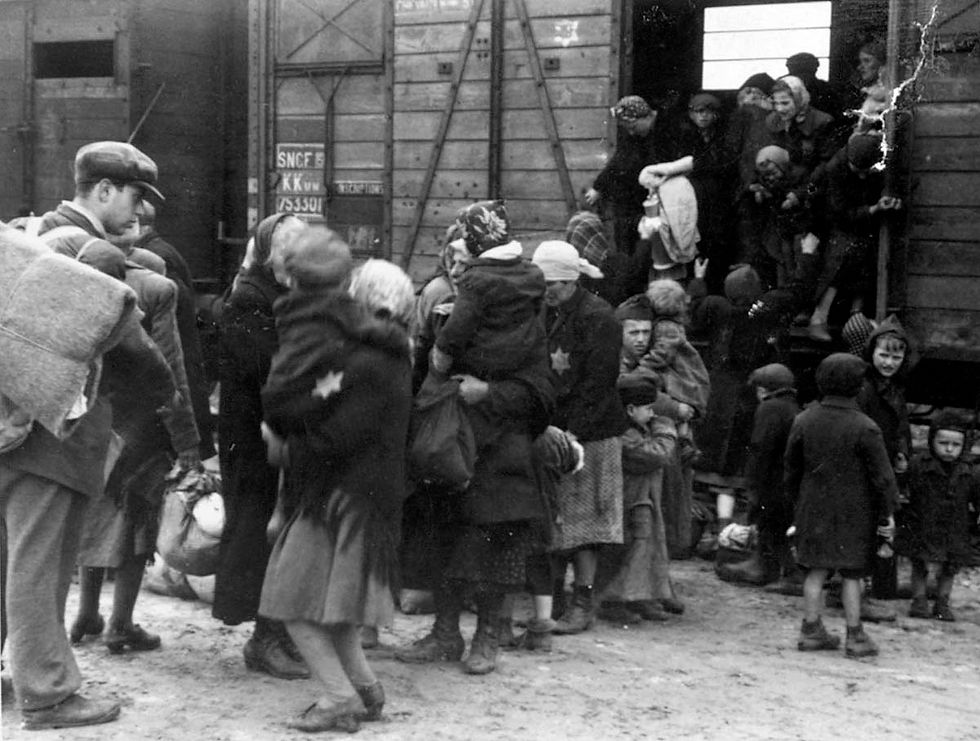
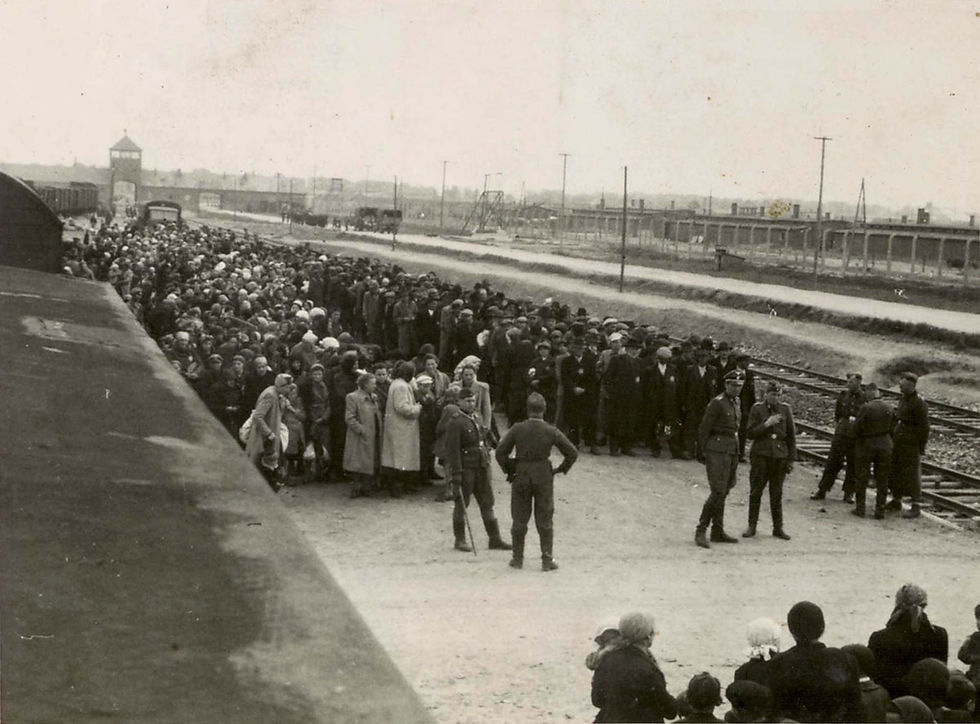
July 9, 1944: After the complete halt of the trains carrying Hungarian Jews, Filip Muller makes this bitter observation: Transporting 400,000 people from Hungary to Birkenau required hundreds of train carriages. But only a few trucks were needed to transport their ashes to the Vistula River.
The average number of people gassed at Birkenau then dropped from 10,000 per day to 1,500 per day.
July 10-12, 1944: Faced with the inevitable advance of the Red Army, the SS authorities begin deporting some 130,000 able-bodied prisoners to other camps, including some 1,600 recently arrived Hungarian Jews to Bergen-Belsen in Germany, to which a "Hungarian camp" is added. But the last Jewish prisoners from Theresienstadt, consisting of families, are gassed and cremated: this amounts to some 5,000 people of all ages. It seems that the camp authorities want to liquidate as many "useless" people as possible before the arrival of the Russians.
The Birkenau camp, now overcrowded with prisoners, is running out of food. Dr. Miklos reports: Hunger had turned the prisoners into raging, moaning madmen. In a few days, their already weakened bodies had completely disintegrated. Diarrhea, dysentery, and typhus had begun their deadly work. Fifty to sixty people died each day. Their last days were an ordeal, until death finally came to set them free.
July 13, 1944: Edmund Veesenmeyer, the German agent in Hungary, sends a report to Berlin stating that the number of Hungarian Jews sent to Birkenau was 437,402, distributed among 147 transports.
July 20, 1944: Failed assassination attempt on Adolf Hitler by officers who want to end the war and, presumably, negotiate with the Western powers before the feared Russian invasion.
July 24, 1944: Liberation of the Polish city of Lublin by the Red Army. The day before, they liberated the Majdanek extermination camp, and for the first time, the horrors of the Nazi camps began to be confirmed. For, in their retreat, the Nazis were unable to destroy all the infrastructure of the death industry, nor eliminate all the prisoners still alive. In fact, the Red Army found thousands of civilian prisoners and prisoners of war, as well as numerous pieces of evidence of the extermination that had taken place there.

July 26, 1944: Dr. Pasche, a Frenchman with the SK commando, continues to record the number of deaths at Birkenau. For May 1944, he had counted 360,000 dead; for June 1944, 512,000; and for the month ending July 26, 442,000. This brings the total to 1,314,000 people murdered at Birkenau in just the three months of May-July 1944.
July 28, 1944: The mass escape plan devised by the SK members is postponed again because 837 prisoners arrive from Majdanek with their SS guards. Given the sudden presence of a large number of guards in Birkenau, also accompanied by fleeing Wehrmacht soldiers, any escape attempt is doomed to failure.
July 27, 1944: With the end of Aktion Höss, the extermination of Hungarian Jews, Nazi officials from the camp travel to Solahütte to celebrate their "success" and Höss' imminent departure. This is a holiday resort in Poland for guards, administrators, and German Nazi auxiliary staff from the Auschwitz-Birkenau camps, located about 30 km from Auschwitz. They drink and sing to accordion music.

July 29, 1944: Rudolf Höss leaves Birkenau and returns to his office near Berlin. He receives the War Merit Cross for the successful mass murder of Hungarian Jews. Richard Baer (former assistant to Oswald Pohl) takes over the management of Auschwitz-Birkenau.
August 1, 1944: Warsaw Uprising, lasting until October 2, 1944. The Russians are on the other side of the Vistula River but do not intervene. The Nazi occupiers brutally suppress the Polish people's revolt, and the Old Town is destroyed. On August 5 alone, the Germans kill some 40,000 Polish civilians.
August 1, 1944: Olga Lengyel, a prisoner attached to the women's camp infirmary, testifies to her imprisonment in the unfinished B-III "Mexico" camp: In another hospital within the camp, section B-III (Mexico), there were approximately 6,000 deportees in August 1944, far fewer than our 35,000 (in camp B-I). There, they had isolated rooms for contagious cases. Characteristic of the camps' irrational organization, this smaller section had an infirmary ten times larger than ours, with fifteen doctors on duty. However, the hygiene conditions there were even more deplorable: there were no latrines, only open wooden chests where the women were watched over by the SS and the prisoners.
August 2, 1944: After liquidating the Theresienstadt family camp, the Berlin authorities order the liquidation of the Roma camp. Only 2,000 people are still alive out of the approximately 23,000 who had been interned in this special B-IIe camp. Most had died of typhus since their arrival at Birkenau. The killing is not simple, however, as the men fight against the SS guards and even against the SK members awaiting them in the gas chamber. Meanwhile, Dr. Mengele manages to extract 14 twins for his experiments and places them in a room in Crematorium 2. He kills them by injection and then has their autopsies performed by Dr. Miklos, who notes : These were children to whom Mengele himself had distributed food, candy, and toys in the camp. They used to greet him with joy, running towards him every time this "kind uncle" appeared.
August 2, 1944: After the gassing of the Roma people, Otto Moll gathers the members of the SK (SonderKommando) in the crematorium and kills the Jewish kapo Jacob Kaminski, who had been organizing their revolt before the gassing. He had likely been denounced. This is a severe blow to the SK's escape plan.
August 4, 1944: Prisoner Alberto Errera manages to take four photographs of the SK commandos at work in the Birkenau woods. We see groups of naked women running towards their deaths, and also SK commandos burning bodies in the open air.

August 9, 1944: The arrival of transports of Jews from the last active ghetto in Poland, Lodz (Litzmannstadt in German), begins, with approximately 70,000 people. They arrive in transports of about 10,000 people, and nearly 95% of them are gassed upon arrival. This deportation continues until August 30, 1944.
August 11, 1944: The first transports of Poles arrested during the Warsaw Uprising arrive at Birkenau.
August 20, 1944: American planes fly over the Auschwitz complex, but once again, they focus on the Monowitz industrial facilities, which are slated for bombing. During a raid on this date, 150 British prisoners of war (including some British) are killed from the bombing.
August 23, 1944: In preparation for the Birkenau uprising, the conspirators arrange with female prisoners at the Weischel Union Metallwerke factory to obtain explosives and metal boxes to make homemade grenades. They manage to produce about thirty.
August 26, 1944: News of the liberation of Paris on August 19 reaches Birkenau. The French prisoners can barely contain their joy. In response, the SS guards hang a Pole and three Frenchmen for spreading "false news."
August 29, 1944: Uprising in Slovakia. The Germans regain control and the transports of Slovak Jews, interrupted for two years, resumes.
August 30, 1944: Otto Moll has the old mass graves in Birkenau wood filled in to conceal what had taken place there.
September 5, 1944: Anne Frank and her family arrive at Birkenau in a transport from the Netherlands. She spends approximately two months there. In November 1944, she is transferred to the Bergen-Belsen concentration camp, where she died in February or March 1945.
September 13, 1944: American bombers carry out several raids on the IG Farben industrial complex in Monowitz. Photographs of Birkenau were also taken, showing the crematoria and a transport on the ramp. Everything resembled a prisoner-of-war camp rather than an extermination camp, and no industrial targets of interest are visible.

September 15, 1944: public hanging of the lovers, Edek Galinski and Mala Zimetbaum, as an example. But both attempt to kill themselves rather than die at the hands of an SS executioner. In both cases, the SS guards intervene. Edek dies shouting "Long live Poland!" As for Mala, she manages to obtain a razor blade and tries to slit her wrists on the gallows. A Slovak prisoner recounts: While she was already on the execution platform, during the reading of the sentence, Mala slashed her wrists with a razor she had prepared beforehand. But, as with Edek, she was not allowed to die that way. Rapportführer Taube rushed towards her, and she slapped him with her bloodied hands. At that very moment, the SS trampled her to death in front of all the women in the camp. She died (in the wheelbarrow) on the way to the crematorium (along Lagerstrasse).

September 23, 1944: Jacob Gabbay recounts the first elimination of SK members from crematoria IV and V, which bodes ill for the fate of the other SK members: In September 1944, the Germans announced: "There isn't enough work; we're transferring two hundred SK prisoners from the crematoria to another location." They brought out all two hundred former prisoners and, at a distance of three or four kilometers from Auschwitz, shot them. We knew nothing about this.
Their bodies are then taken back to Crematorium III and, unusually, are burned by the SS themselves, while the SK members at this crematorium are confined to barracks. They are, however, made to take their clothes with them.
September 25, 1944: Otto Moll is relieved of his duties at the Birkenau crematoria, and Peter Voss returns to his post.
September 27, 1944: Maurice Rossel, delegate of the International Committee of the Red Cross (ICRC), makes an impromptu visit to Auschwitz. This visit was not planned, but he is nevertheless received by Commandant Höss, who simply showed him a few brick buildings at Auschwitz. He obviously does not visit the Birkenau site, where the prisoners look like the living dead, nor the extermination facilities. His report thus mentions that he saw no systematic extermination, only red-brick barracks, and that he observed the prisoners' poor health.
It should be noted that Rossel's initiative could not be official because, at that time, the ICRC was only mandated to verify the conditions of detention of prisoners of war, not those of detained civilians. This formal mandate to protect civilians would not be consolidated until the Fourth Geneva Convention in 1949.
September 28, 1944: liquidation of the B-IIc women's camp. This affected approximately 4,000 detainees. The decision is made by Mengele. He cites the risk of an epidemic, but it is undoubtedly the lack of food to supply the camp as the primary reason. The women are transported by dump trucks, mostly in resigned silence. As Dr. Miklos noted, for them, life had lost all meaning and purpose; prolonging it would only have prolonged their suffering. The trucks arrive in front of the crematoria and unload the prisoners to be gassed and then cremated.
October 5, 1944: attempted liquidation of another group of SK members by disguised means. Peter Voss draws up a list of 300 people whom he claims he must send to another camp. The SK members rush to carry out their mass escape plan, or else they will be gassed little by little in groups of 200-300. All those who took notes or wrote down testimonies hide them in boxes and bury them in the grounds or ashes around their crematorium. Several of these writings will be found after the war.
October 7, 1944: This is the day of the SonderKommando (SK) revolt at Birkenau. It is triggered in a panic at Crematorium IV, without waiting for nightfall, because Voss' selection process was imminent for those at Crematoriums IV and V. A few SK members from Crematorium IV set fire to the wooden structures in the early afternoon when SS trucks arrive to collect those designated for "transfer" to another camp. Seeing the smoke from a distance, SK members from Crematorium II blow up the crematorium oven room, and a battle ensued, but the SS secure the area with their machine guns.
A few weeks earlier, there were approximately 860 SK members at Birkenau; then 200 were liquidated. Afterward, about 250 die during the revolt, another 200 are executed in reprisal, and 212 others are left alive to maintain operations at the last active crematorium, Crematorium III (whose SK members do not revolt because they are taken unprepared by the spontaneous triggering of the fire at IV). During the revolt, three guards are killed, one of whom is thrown alive into an oven.
October 14, 1944: a Gestapo investigation is conducted at the camp's munitions factory to identify the female prisoners who had supplied explosives to SK members.
October 15, 1944: coup d'état in Hungary: Horthy is deposed by the Germans to prevent Hungary from joining the Allies. Hungarian fascists again target Jews.
October 20, 1944: liquidation of all boys under the age of 18. This amounts to approximately 600 boys. Mengele, however, manages to keep his "guinea pigs." Leib Langfuss, a remaining SK member, recounts the scene in front of the crematorium: They were wearing long, striped suits (adult-sized), worn to a thread, and tattered shoes or clogs. The boys were so handsome and well-built that even their rags couldn't conceal it. They understood at once that they were being led to their deaths. Panicked, they began to run around the courtyard (of the crematorium), tearing at their hair, not knowing how to escape. Many began to sob, and piercing wails rose from their throats. The commando leader and his assistant beat them to force them to undress, so violently that they broke their truncheons. Many of them ran desperately toward the Jews in the SK, clinging to them and begging them to let them live. We stood paralyzed by their heart-rending cries. The SS officers, with smug smiles on their lips, without the slightest pity, with the proud air of victors, shoved them with their fists into the gas chamber.
October 27, 1944: the dismantling of the useless crematoria begins. Jacob Gabbay recounts: There were no more large transports arriving; twenty days after the revolt (of October 7th), the whole affair had ceased. The destruction of the crematoria then began. During all this time, we were extremely tense, because we thought they would kill us to prevent us from revealing to the world the truth about what was happening at Auschwitz.
October 28, 1944: the last gassing of prisoners is carried out at Birkenau for a transport of Jews deported from the Theresienstadt model camp. It involves 2,000 people. Only about 15% are selected for forced labor, and the others are sent to their deaths.
October 31, 1944: Himmler gives the order to stop the gassings.
November 1, 1944: the date of the last mass selection at Birkenau. It concerned the women's camp, B-I. Olga Lengyel, a prisoner attached to the camp's infirmary, recounts: As the Red Army advanced across the Polish plain, hope was reborn in our hearts. Those who encountered Herr (Josef) Kramer during his inspections reported that he seemed increasingly anxious. One day, he gave the following order: 'Camp No. 1 must be liquidated tomorrow at noon. It must be completely empty for inspection. Signed: Kramer.' The number of internees had already decreased, but there were still approximately 20,000 women. Transferring such a large number of deportees to Germany in such a short time was virtually impossible. Yet, Kramer's order was carried out within the allotted time." The following afternoon, nothing remained at Camp No. 1 except the hospital with its thousand patients and the hospital staff, including us, in the infirmary. We had no illusions about the fate that awaited our patients and ourselves. […] We spent a sleepless night, all preoccupied with the same thing: the death that lurked behind the dawning day. […] We arrived at the hospital. A few moments later, Dr. Mengele appeared, followed by twenty SS guards. A few minutes later, Josef Kramer entered with a determined stride. Without responding to the greetings of his subordinates, he stopped in the middle of the room, legs apart, hands behind his back. He barked orders at his lieutenant. One of the ambulances used to transport victims to the gas chamber stopped in front of the hospital, followed by others. Between the hospital entrance and the ambulances, the SS formed a cordon. Other SS men ordered the patients into the vehicles. Most of the patients were too weak to stand, but the guards began beating them with their clubs and whips. One woman, who hadn't even started walking, was grabbed by the hair. In the melee, many women fell from the koias (the bunk beds) and fractured their skulls. My comrades and I, powerless in the face of this horrific scene, stood frozen with terror and rage. A few patients tried to escape or resist, but the SS men rushed into the ranks and beat them mercilessly. It's indescribable. Kramer then assigned us a "medical" task: to remove the patients' gowns, the only clothing these poor women had left, dragged from their beds and moaning under the blows of the whip. What reason could possibly justify such a request? These gowns were nothing but rags, but no one asked questions. […] I couldn't say exactly how many ambulances and trucks full of sick people left that day for the crematoria. And to this day, I only have a hazy memory of it, as if through a fog. I see those horrible SS men, seized by a destructive madness, blindly beating the sick, kicking pregnant women. Kramer himself had lost his composure. A strange gleam shone in his small eyes, and he worked like a madman. I saw him throw himself on a poor woman and, with a single blow of his truncheon, smash her skull. Blood, nothing but blood. Blood everywhere! On the floor, the walls, the SS uniforms, their boots. Finally, once the last ambulance had left, Kramer ordered us to scrub the floor and put the room back in order. Strangely, he lingered and supervised the cleaning himself. We worked like automatons, incapable of thinking, of understanding. One thought haunted us: would death soon strike us?
November 25, 1944: Himmler gives the order to dismantle the superfluous crematoria. After the Majdanek fiasco, when the Red Army managed to capture the camp along with its gas chamber facilities, he wants to leave no trace of the mass extermination that was taking place at Auschwitz-Birkenau. Therefore, crematoria II and III, the closest to the "ramp," begin to be dismantled. Since crematorium IV had been destroyed during the October Uprising, only crematorium V remains operational for cremating corpses. At the same time, given the number of guards and other personnel being transferred to other camps, Nazi vigilance at Birkenau begins to decrease. The Nazis are well aware that the camp will have to be evacuated at any moment, depending on the Red Army's advance.
November 25, 1944: Josef Kramer is transferred from Birkenau and sent to command the Bergen-Belsen camp in Germany, following a recommendation from Höss to Pohl. He takes up his post there on December 1, 1944. This change follows Höss' inspection of the camp, which he describes as follows: The camp was in a deplorable state. The prisoners' barracks, the staff buildings, and even the guards' barracks were in ruins. The sanitary conditions were far worse than at Auschwitz. Despite everything I was used to at Auschwitz, I too must describe the conditions here as terrible.
November 26, 1944: final selection among the approximately 200 remaining SK members. Since gassing was now prohibited, those chosen were executed by firing squad and their bodies cremated at Crematorium V. The pious Lejb Langfuss, who arrived at Birkenau on December 9, 1942, was among this last selection. He survived for nearly two years in the SonderKommando.
Approximately 98 SK members are left alive, 30 of whom remain assigned to the last crematorium to cremate the deceased prisoners. Most of them would survive the war and witness the workings of the Nazi death industry.
November 29, 1944: the Gestapo investigation at the munitions factory, to identify the female prisoners who had supplied explosives to SK members, bears fruit. They are four Polish Jewish women who would be tortured and then publicly hanged in early January 1945.
December 5, 1944: nearly 100 female prisoners are assigned to assist SK members in the demolition of Crematoria II and III. The aim is to hasten this demolition before the arrival of the Russians. This is the first time in the history of Auschwitz that female prisoners had entered a crematorium and emerged alive!
December 21, 1944: Himmler orders the evacuation of the Auschwitz camps.
December 21, 1944: aerial photographs taken by American planes that day show that, at Birkenau, the fence and watchtowers of B-III "Mexico" had been dismantled, the roof of the gas chamber and the underground changing room of Crematorium II had been removed, and the fence around Crematoria II and III had been taken down. The area around the crematoria is littered with ruins.
December 26, 1944: American bombing of the IG Farben industrial complex in Monowitz. The next bombing would take place on January 19, 1945.
December 31, 1944: in preparation for the camp's evacuation, it is decided to eliminate the children who are still able-bodied rather than subject them to the "death march." Since the gas chambers are no longer operational, the Nazis resorted to a cruel stratagem, described in my other article: click here.
To return to the previous timeline or advance to the next, click below.
January-June 1944 Timeline <<< Navigation >>> 1945-1946 Timeline
Albert Benhamou
Private tour guide in Israel
May 2026


Comments