


Auschwitz timeline: 1945-1946
Before continuing with this timeline of the history of the Auschwitz camp, please ensure you have read the previous timelines, starting with the period 1940-1941. To read them, click here. Here we conclude the timeline with the years 1945-1946.
January 1, 1945: only Crematorium V remains in use. Approximately 100 members of the SK (SonderKommando) are still alive, 30 of whom are assigned to this crematorium.
January 5, 1945: several Polish prisoners from the camp, members of the SK and kapos, are transferred to the Mauthausen camp and marked as "bearers of the secret" (of the extermination of the Jews). They are shot on April 3, 1945, to eliminate any witnesses, and cremated.
January 6, 1945: seventy Poles are executed after being sentenced by a court-martial. Furthermore, the four Jewish female prisoners assigned to the munitions factory, and accused of supplying dynamite to SK members for the October 7, 1944 uprising, are publicly hanged as an example.
January 10, 1945: what remains of the SonderKommando is moved to Block 16 of sector B-IId at Birkenau. This block is not isolated from the others, and for the first time, they are allowed to move freely within camp B-IId.
January 15, 1945: for the first time, sounds of fighting are heard in the distance: a sign that the Red Army is approaching.
January 17, 1945: Dr. Mengele, the camp's chief physician, is eager to abandon his post as soon as possible... Prisoner Olga Lengyel, assigned to the infirmary, recounts: Dr. Mengele was a coward: those who worked in the Schreibstube (administrative office) knew he used despicable tricks to avoid the front. When the SS left the camp en masse, Mengele found a special mission that made his presence at Birkenau indispensable. One day, he came to the infirmary and declared that, through our negligence, the typhus epidemic had reached such proportions that the entire Auschwitz region was threatened. Unfortunately, typhus epidemics were raging in the camp, but at that time, we had relatively few victims. That same day, he sent us a large quantity of serum and ordered mass vaccinations. We were working from 6:00 a.m. in front of the infirmary, because Dr. Mengele had forbidden us to administer vaccinations inside. It was cold and our fingers were numb, but thousands of internees were waiting to be vaccinated, and we had to work tirelessly until late into the night. Dr. Mengele was pressed for time; he needed an impressive report to send to Berlin (for his own personal reasons and to leave Birkenau) as quickly as possible. His behavior was aberrant. He accused us of sabotaging the vaccinations; so, obeying his order, we suspended the vaccinations the next day. Immediately, he flew into a rage and accused us, once again, of sabotage.
Finally, Mengele leaves Birkenau in haste on January 17, 1945, with his "urgent" medical report to take to Berlin. He gets into his overcrowded car and abandons his pathologists and his twins to their fate.
January 17, 1945: the Nazis began the evacuation of Birkenau that day and in the days that followed. The prisoners are forced to march in their rags, through the snow and the January cold. Those who collapse from exhaustion are immediately shot by the SS guards accompanying the march. In total, some 60,000 prisoners are forced on this "death march," of whom approximately 15,000 will not survive.
January 17, 1945: that evening, the prisoners at Birkenau undergo their final "roll call," after which they are immediately sent to Auschwitz I. This roll call also includes members of the SonderKommando (SK), whom the SS then instruct to go to Block 16 of Sector B-IId and wait there. The SK members suspect that, once the "regular" prisoners are evacuated from the camp, the SS would come to shoot the SK members as inconvenient witnesses.
January 17, 1945: on the same day as the evacuation of Auschwitz, Hitler enters his bunker in Berlin and would not emerge until his suicide. Coincidentally, this date is the 3rd of Shevat in the Hebrew calendar, and it was on the 3rd of Shevat in 1933 (which fell on January 30th) that Hitler was chosen Chancellor of Germany. Thus, the day he rose to power was also the day he descended into darkness.
January 18, 1945: the Russian Army liberates Krakow, located 60 km east of Auschwitz. The evacuation of the Birkenau camp is completed that day. SS members discreetly mingle with the other prisoners in the departure ranks. The SS guards pay little attention, as they are too busy getting the long procession westward underway as quickly as possible. It is likely that the last SS members of the Gestapo begin searching for the SK members, but given that the prisoner lists and other records have already been burned the previous day and that no list exists of the prisoners to be evacuated, it is impossible for them, given the lack of time, to find these SK members in the mass of departing prisoners.
Finally, at midnight on the night of January 18-19, the departure takes place. Jacob Gabbay recounts: An icy wind was blowing, the temperature was -20°C, and the ground was covered in snow. Our march began; we left Auschwitz behind. Every second, we heard the sound of "boom-boom" (from the Russian artillery). Anyone who couldn't walk was shot. The snow was red with blood.
A group of SS men and the sick prisoners, including the children left behind by Mengele, remain in the camp.
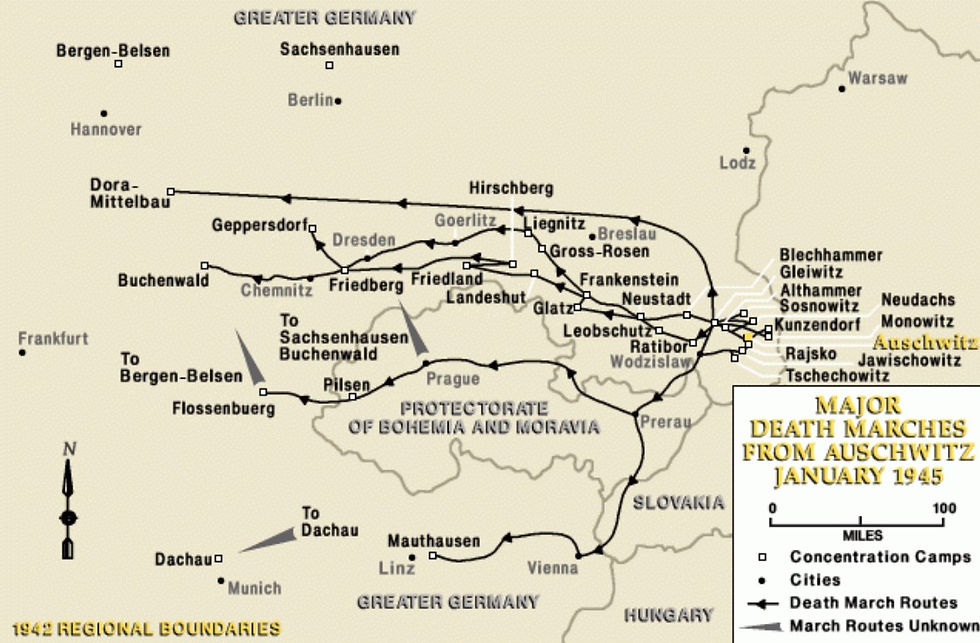
January 19, 1945: final bombing by the US Air Force against the IG Farben industrial center in Monowitz, one day after the evacuation of the prisoners (including Elie Wiesel and his father). As for Primo Levi, also imprisoned in Monowitz, he is ill and remains in the camp infirmary until the camp is liberated by the Russians.
January 19, 1945: the SK members, hidden among the prisoners, nevertheless stand out due to their apparent good health and their appropriate clothing for the march. They had always benefited from the SS's generosity in their work, both in terms of food and clothing, which they were able to obtain from members of Kanada. A denunciation, out of jealousy of their situation, to the SS guards would have been a death sentence. Jacob Gabbay recounts: Around ten o'clock in the morning, we arrived in a Polish village. A few prisoners of Polish origin who knew the way and spoke the language managed to escape.
We were asked, "How come everyone is starving? You're the only ones who look healthy?" We didn't tell them we were in the SK; we said we had been doing all sorts of work and that we had simply been able to hold out.
January 19, 1917: Rudolf Höss, who had been sent by Berlin to Auschwitz to help prepare the prisoners' departure, arrives too late but encounters the long, motley procession that day. He described it: I saw columns of prisoners struggling through the deep snow, without food. Most of the non-commissioned officers leading this procession of the living dead no longer knew where to go. It was easy to follow this trail of human suffering because every few hundred meters, one came across a collapsed or shot prisoner. The dead by the roadside were not only prisoners, but also refugees, women, and children. At the edge of a village, I saw a woman sitting on a tree stump, cradling her child and singing. The child had been dead for some time, and the woman had lost her mind.
The presence of civilians on this death march is understandable. Since Auschwitz was located in the part of Poland that had been annexed to the Reich, and populated by German-speaking Poles, they too could fear ill-treatment at the hands of the Russians!
January 20, 1945: on this date, an advance guard of the Red Army reaches within 60 km east of Berlin! But the final assault on the Reich's capital would not begin until three months later, after the Red Army would finally secure the entire front. Panic gripped the German ranks. SS Lieutenant General Schmauser (commander of the Auschwitz region) orders the immediate execution of all prisoners who had been unable to leave the camps with the march. He had received instructions from Pohl, who had relayed Himmler's message that no disabled prisoners should be left in the camps. A group of SS men immediately carries out his order. They remove the approximately 200 sick women from the camp and shoot them. Then they blow up crematoria II and III, whose manual demolition had been left unfinished. In the following days, approximately 700 more prisoners from Auschwitz, Birkenau, and the subcamps are shot by this SS group led by work section chief Richard Perschel. However, some 8,000 prisoners and sick individuals at Auschwitz, Birkenau, and Monowitz escape sure death because the last SS men flee on January 25th before the arrival of the Soviet soldiers.

January 21, 1945: back in Berlin, Höss learns that the Red Army will soon reach the city gates. Soviet forces number over two million soldiers, 100,000 vehicles, and 6,000 tanks, while Berlin continued to endure relentless Allied air raids. When Hedwig Höss sees her husband again, she questions their future: How will we win the war? Do we still have any advantages that could tip the scales in our favor? But Höss has no reason to hope. He had witnessed Germany's decline in recent months. Therefore, in response, he begins to organize his family's departure from the capital. His plan is to settle them in northern Germany, near his brother-in-law.
January 23, 1945: the SS set fire to the Kanada barracks and warehouses at Birkenau, in an attempt to destroy all traces of the personal belongings of the gassed prisoners.
January 25, 1945: during the night around 1:00 a.m., Crematorium V, the only remaining intact structure, is dynamited by the last SS group before they flee.
January 27, 1945: the first Red Army soldiers arrive at Auschwitz around 3:00 p.m. In the surrounding area, they find survivors: approximately 1,200 at Auschwitz, approximately 5,800 at Birkenau, and 600 at Monowitz. In an improbable but true story, it is a Jewish soldier from the Red Army (Ukrainian Division) who first enters Birkenau with his T-34 tank: David Dushman. He recounted: We threw all our canned goods at them and immediately began hunting down the fascists. Dushman died in 2021 at the age of 98.
Red Army General Vasily Petrenko stated: I, who saw people dying every day, was horrified by the indescribable hatred of the Nazis toward the prisoners, reduced to living skeletons. I had read in various leaflets accounts of the treatment inflicted on Jews by the Nazis, but nothing about the treatment of women, children, and the elderly. It was at Auschwitz that I discovered the fate of the Jews.

February 7, 1945: all the survivors found at Birkenau are transported by Russian soldiers to Auschwitz, which offers better living conditions in brick buildings. This transfer takes approximately two weeks.
April 28, 1945: Hitler writes his will. Until the very end, his fierce hatred for the Jews is the reason for all his thoughts. He again accuses them of being responsible for the war. This is his justification for the German defeat. He commits suicide two days later.
April 28, 1945: in Flensburg, at the Naval Academy and Admiral Doznitz's headquarters, Himmler gives a final speech to the SS officials present, including Rudolf Höss. He declares: Destiny has reserved a great mission for me, which I must accomplish alone. Here, then, is my last order: disappear into the Wehrmacht! In a way, conceal your SS past and present yourselves as ordinary officers in the regular army.
And Höss later noted in his memoirs: Such was the farewell message of the man I so admired, in whom I had unwavering faith, and whose orders, every word of which, were gospel truth to me. But Höss nevertheless obeys his master's last order, takes a naval uniform, and attempts to pass himself off as a simple member of the Kriegsmarine, the German navy.
May 5, 1945: German surrender and Armistice Day.
May 7, 1945: the Soviet news agency TASS informs the world of the crimes and atrocities discovered during the liberation of Auschwitz, after Russian doctors were sent there to examine former prisoners and gather their testimonies.
May 18, 1945: in the Bergen-Belsen camp, liberated by the British, Dr. Fritz Klein, who had worked at Birkenau, recounted during an interrogation: upon the arrival of the transports at Auschwitz, it was the doctors' responsibility to select those unfit or unable to work, including children, the elderly, and the sick. I saw the gas chambers and crematoria at Auschwitz and I knew that the people I selected were destined for the gas chamber, but I was only obeying the orders of Dr. Wirths (the chief physician). I couldn't say from whom Dr. Wirths received his orders, and I never saw a written order concerning the gassing of prisoners. […] Although SS guards were present, they did not actively participate in the selection of those unfit for work. […] I never protested against sending people to the gas chamber, even though I never consented to it; one cannot protest in the army. […] I heard that Himmler visited the Auschwitz camp, although I never saw him. The higher authorities were well aware that these methods were used at Auschwitz.
May 23, 1945: Himmler commits suicide shortly after his capture when he realizes that the Allies will make no concessions to him, having been responsible for the extermination of millions of people.
May 24, 1945: a Polish committee against war crimes is established in Krakow. Several former members of the SK return to Auschwitz to testify. One of them, Henryk Tauber, is a key eyewitness and the first to mention Josef Mengele, nicknamed the Angel of Death.
September 17, 1945: at the Bergen-Belsen trial in Lünebruck, Rudolf Höss' name and role surfaces. Josef Kramer, who had been his deputy at Auschwitz, testified that Höss had overseen the construction and operation of the gas chambers that killed millions of people. The New York Times described Höss as "the missing figure" at the trial. British authorities launch a search for Höss. He is found in May 1946.

November 17, 1945: the Bergen-Belsen trial concludes in Lünebruck. Of the 45 defendants, 30 are found guilty of war crimes: 19 are sentenced to prison terms and 11 to death by hanging. Several of these SS officers had served at Auschwitz and Birkenau before Bergen-Belsen.
November 20, 1945: the Nuremberg Trials against the Nazi leaders begin. They will last until October 1, 1946. At the opening of the trial, Chief Judge Robert Jackson declares: The wrongs which we seek to condemn and punish have been so calculated, so malicious, and so devastating that civilization cannot tolerate their being ignored, for it cannot survive their repetition.
December 13, 1945: the condemned SS from Bergen-Belsen trial are executed by hanging. The list includes Josef Kramer and Dr. Klein, but also female guards, including Irma Grese, nicknamed "the female dog of Belsen." During her service in the women's camp at Birkenau, she always had a German Shepherd by her side.
March 12, 1946: Rudolf Höss is arrested. The announcement of his capture causes a sensation in the press, especially since the Nuremberg trials were stalled because Nazi leaders were trying to feign ignorance of the Final Solution and the prosecution lacked evidence and witnesses. However, Höss' crimes had been committed in Poland, and the Allies had pledged to bring war criminals to justice in the countries where their crimes had been committed. Höss is therefore to be tried by a Polish tribunal. But an American prosecutor in Nuremberg had the idea of calling Höss to testify as a witness, not as a defendant, in order to confirm the genocide! This amounts to using Höss as a prosecution witness to expose the Nazi leaders who claim to be unaware of the genocide.
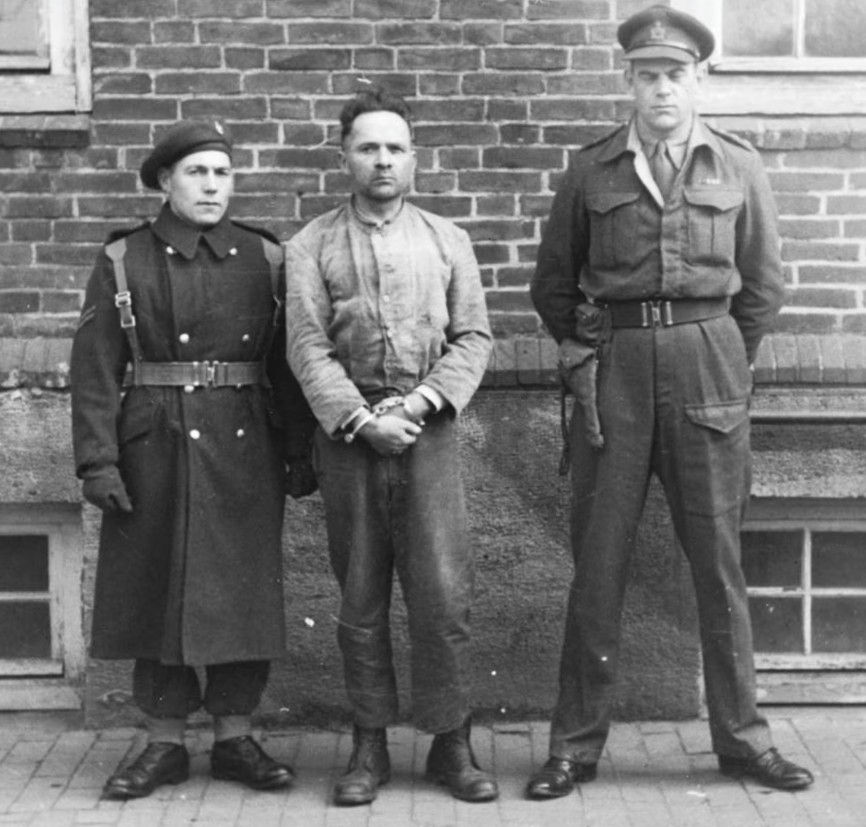
April 1, 1946: Höss arrives in Nuremberg as a witness. He is first questioned by the prosecutor and then by a psychiatrist, to whom he declares: You see, in Germany, we understand that if something goes wrong, whoever gave the orders is responsible. [...] I am perfectly normal. [...] Even during my extermination work, I led a normal family life. Later, he also says: I was simply the director of the extermination program at Auschwitz. Hitler ordered it through Himmler, and Eichmann gave me the orders concerning the transports.
April 15, 1946: Rudolf Höss takes the witness stand at the Nuremberg Trials. He states: I commanded Auschwitz until December 1, 1943, and I estimate that at least 2,500,000 victims were executed and exterminated there by gassing and immolation, and that at least half a million others succumbed to starvation and disease, bringing the total number of deaths to approximately 3,000,000. This figure represents about 70% to 80% of all those sent to Auschwitz as prisoners, the remainder having been selected and used as slave labor in the concentration camp's industries. Among those executed and burned were approximately 20,000 Russian prisoners of war (previously selected by the Gestapo for the prisoner-of-war cages) who were transported to Auschwitz in Wehrmacht convoys driven by regular Wehrmacht officers and soldiers. The remaining total number of victims included approximately 100,000 German Jews, as well as a large number of citizens (mostly Jewish) from the Netherlands, France, Belgium, Poland, Hungary, Czechoslovakia, Greece, and other countries. We executed approximately 400,000 Hungarian Jews at Auschwitz alone during the summer of 1944.
One commentator expresses the general feeling in the courtroom: The most painful moment of the entire trial was hearing a man confess, with his own mouth, to having coldly exterminated two and a half million people. This is something that will be talked about for a thousand years. Even Hermann Göring shares his shock after hearing Höss's testimony.

April 16, 1946: Hans Frank, the former head of the General Government, is questioned again in Nuremberg. Question: Did you participate in the extermination of the Jews? His answer this time is affirmative: Yes, because I have been consumed by guilt for five months, and in particular by Rudolf Höss's statement. The prosecution can finally breathe a sigh of relief: the main war criminals are about to begin confessing their guilt.
May 25, 1946: Höss is then sent to Kraków for his own trial at the site of his crimes. However, his trial ultimately takes place in Warsaw from March 11 to 29, 1947. In the meantime, in Kraków, he writes his memoirs at the suggestion of the judge, who recommends that he records notes on the camp's operations, the character of the SS officers under his command, and so on.
After his trial, in which no fewer than 80 former prisoners testified, Höss is sentenced to death on April 2, 1947, for the deaths of 300,000 Poles and Russian prisoners of war, and 4 million Jews. Höss is hanged on April 16, 1947, at the Auschwitz concentration camp, on the very spot where prisoners had been hanged, next to the crematorium and the house where he had lived with his family.

To return to the previous timeline, click below.
Timeline July-December 1944 <<< Navigation
This is the end of this timeline. Please feel free to contact me if you find any errors or if a photo has been allocated to the wrong owner by mistake.
Albert Benhamou
Private tour guide in Israel
May 2026


Comments